It’s not the first time the 730’ bulk carrier sat high in the St. Lawrence Seaway Lock #3 at Beauharnois. Fifty-seven years earlier the almost brand new chamber was used to raise the then named PIONEER CHALLENGER 41 feet above Lac-St.-Louis during her upbound journey to start a new lease on life as the Great Lakes ore carrier.
 |
| We see it as a disrespectful branding but it's a normal occurrence for an overseas dismantling, to have the ship's name is painted over and shortened. VICTO is all that remains from her previous name, AMERICAN VICTORY. |
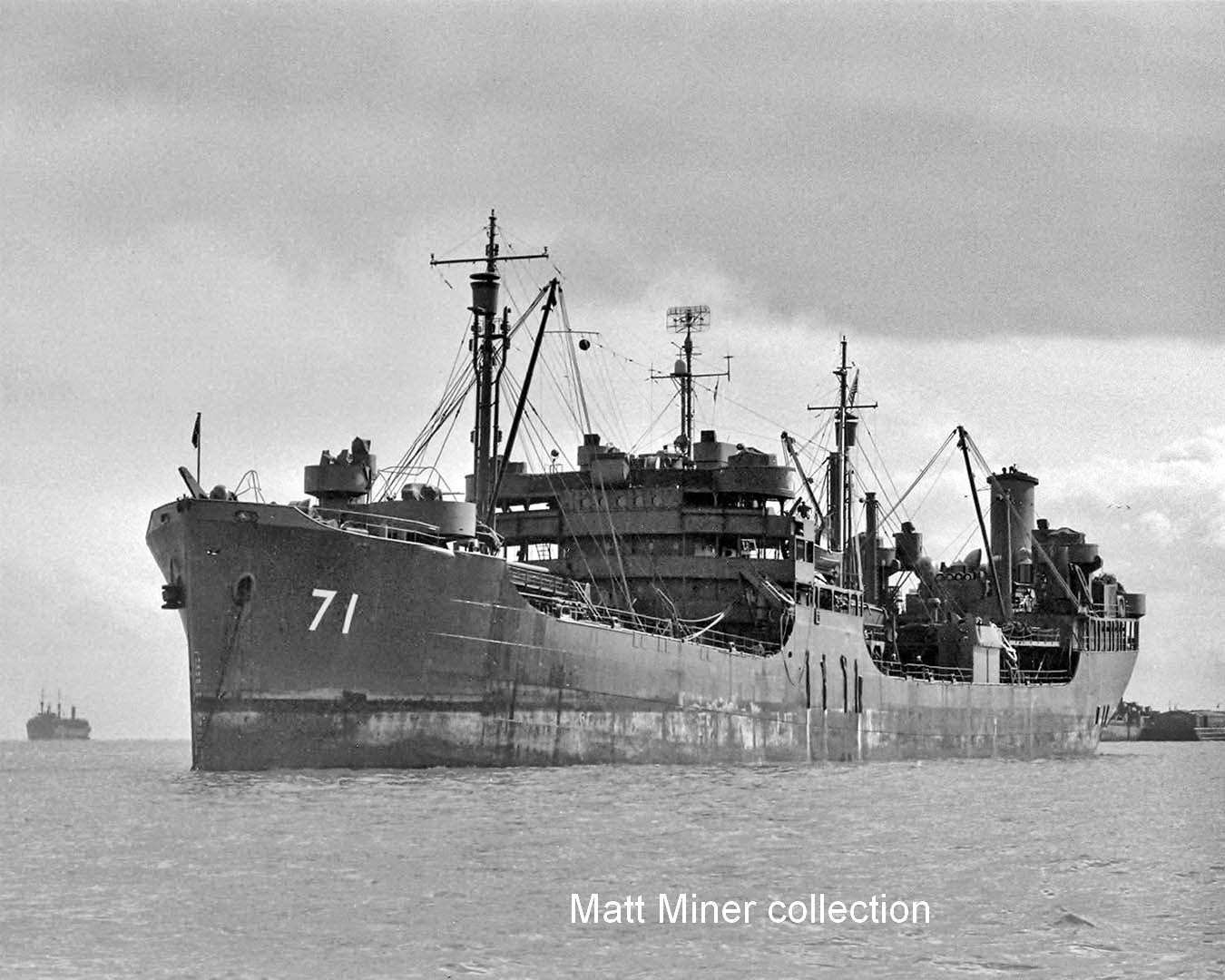
She was just short of 502’ and named MARQUETTE when launched on Halloween Day in 1942 at the Bethlehem Steel’s Sparrow Point, Maryland shipyard however when the U.S. Navy auxiliary oiler went into service on February 20, 1943 she was named after a New Jersey river, USS NESHANIC (AO-71). The NESHANIC was a Chiwawa-class T-3 tanker which was a larger and faster version of the T2 tankers. The T3 had a total load capacity of a approximately 24,830 tons or up to 200,000 barrels of oil. The normal length of a T3 was 500 to 600 feet and had a top speed of 15 to 18 knots (or 23 to 33 km/hour or 17 to 21 mph).
 |
| While her 9 Battle Stars were fortunately missing during her final journey, the original ship's U.S. Navy hull designation, is proudly present on the wheelhouse from when she was the fleet oiler, USS NESHANIC (AO-71) |
The NESHANIC's hull designation was "AO" which meant she was a T3 fleet oiler. Other hull designations were AOG meaning the ship was a T3 gasoline tanker and the AOR hull designation denoted that the T3 was a replenishment oiler which meant it was also able to transfer provisions including ammunition as well as fuel oil.
While underway USS NESHANIC relied on escorts to fend off enemy submarines, however in the case of an air attack, the NESHANIC was armed with a 5 inch 38 caliber gun mount, four single 3 inch 50 caliber gun mounts, four twin 40 mm AA gun mounts and six twin 20 mm AA gun.
During her first year of service, USS NESHANIC (AO-71) saw action almost immediately on both the Atlantic and Pacific Oceans, being involved with both enemy submarines and air attacks in her first year of service.
 |
| Boatnerd.com photo from Matt Miner Collection |
Later in 1943 she served in areas of the Fiji Islands fueling naval fleet but not directly involved in any air attacks. In 1944 she saw heavy action in the Pacific including famous battle zones such as Iwo Jima, Saipan, Guam, Okinawa and the Marianas. On June 18, 1944 she was refueling a destroyer escort near Saipan when five Japanese planes were spotted heading their way. Despite the evasive action taken and heavy gun fire by her crew, one plane hit the
NESHANIC with a bomb. Damage only consisted of some bent steel that would remain visible later in the gallant ship’s life, however the smaller T2 fleet oiler,
USS SARANAC (AO-74) was heavily damaged including a completely demolished sick bay (or ship's emergency room). While sitting along side, the crew of
NESHANIC took the most serious injured sailors aboard for care by her ship’s doctor. The
NESHANIC proceeded to Eniwetok, an atoll in the Marshal Islands, and after three weeks to tend to her repairs and care for her injured,
NESHANIC returned to service for the final months of conflict.
 |
| Boatnerd.com photo from Robert Hurst Collection |
Though she had received nine Battle Stars for her service, the NESHANIC was no longer needed after war and was decommissioned on December 19, 1945. After sitting idle or being "mothballed" for more than a year, the T3 tanker was sold to Gulf Oil Company of Philadelphia, Pennsylvania and started service as the GULFOIL. She remained busy for over 14 years until a horrific accident ended her career as a tanker. In the early morning of August 7, 1958, the GULFOIL collided with another tanker the S.E. GRAHAM near Newport, Rhode Island. The GRAHAM was carrying over 5,000,000 tons of gasoline and exploded immediately. The spectacular fire that burned for over 5 hours resulted in the S.E. GRAHAM sinking and of 17 crewmen killed, 15 were from the GULFOIL which was eventually beached to avoid sinking as well. The burned out GULFOIL was taken to Maryland Shipbuilding and Dry Dock Company in Baltimore where it was determined that she was virtually unrepairable as a tanker. However there was only light damage to her engines and boilers and it was determined her stern section and cabins could be salvaged.
 |
| While on her maiden voyage into the Great Lakes, the late George Ayoub of Ottawa captured the upbound PIONEER CHALLENGER at the almost brand new Iroquois Lock in July 1961 - The photo is a scan from the Paul G. Wiening book, Reflections: Stories of the Great Lakes It's very good read. |
Things weren’t looking very good for the WWII veteran however as we use to say in marketing, "one company’s misfortune can be another’s opportunity" and with a need to replace older vessels on the Great Lakes, Pioneer Steamship Company of Cleveland purchased the burned out hulk as is. After several months in dry dock which included the attachment of a new midsection that was built in Rotterdam to the stern and bow sections, the refurbishment of salvaged after-quarters, and a rebuilt wheelhouse and forward cabin moved from the the former T3’s midsection to the bow, the 730’ x 36’ converted ore carrier was delivered to her new owner 1961.
The rechristened PIONEER CHALLENGER departed Baltimore shipyard on July 1, 1961 bound for Sept Iles, Quebec and then after transiting the St. Lawrence Seaway and Welland Canal, arrived at Cleveland, Ohio on July 14. While delivering her first cargo, coal from Toledo to Indiana Harbor, the PIONEER CHALLENGER would have able to test her 7,700 hp steam turbine power plant which allowed her to reach 16 knots fully loaded.
 |
| On a frosty late December day in 1976, Jim Hoffman of Toledo, Ohio captured the then named MIDDLETOWN with her skinny tanker bow coated in ice as the gearless straightdecker approached the C&O Ore Dock at Toledo. Nice pic. Thanks Jim. |
When Hutchinson Company which operated the Pioneer Steamship’s fleet was disbanded at the end of 1961, PIONEER CHALLENGER was sold to the Columbia Transportation, a division of Olgebay Norton company and her name was changed to MIDDLETOWN in 1962. Over the next 20 years the WWII veteran remained busy carrying talconite ore pellets from the Reserve of Mining Company in Silver Bay, Minnesota down to the Torco dock in Toledo.
It was and remains a common trade route for the vessels of the wall will be Norton fleet although the MIDDLETOWN would make visits to other loading and unloading porch. As the steel industry and shipping on the Great Lakes entered a downturn in 1982, the Middletown received a reprieve which kept her from a permanent departure from the Great Lakes. The MIDDLETOWN was converted to a self unloader at Bay Shipbuilding in Sturgeon Bay and this not only cut down on her unloading time but also allowed her to move more flexibility in port switch can visit as well as being profitable and different types of cargoes. They MIDDLETOWN was converted to a self a motor at bay and shipbuilding company in Sturgeon Bay and this not only cut down her unloading time but also allowed for more flexibility imports she can visit as well as being profitable and different types of cargoes. Because of the whole design of the vessel including the old saltwater Tanker parts, the deck apparatus of the MIDDLETOWN so soft on loading system was built to a lower profile then they ship building companies other conversions in the area and much lower than the Frazer Shipyards conversions.
 |
A great capture by Marc Dease at Point Edward's Waterfront Park of
the downbound and fully loaded AMERICAN VICTORY coming in off of
Lake Huron on August 22, 2008 - Thanks Marc for the pic and telling
me about that wonderful place to photograph vessel of all kinds.
|
MIDDLETOWN’s new self unloading equipment was quickly put to use
taking on more coal cargoes. However during one coal run on September 15, 1986
methane gas had gathered which ignited in her boiler room causing an explosion.
Just like she did during her WW II duties, the MIDDLETOWN raced to the nearest
port to tend to her injured crewmen. Since that incident, all coal
carriers are required to take regular gas readings to prevent another
explosion.
Throughout the 90’s MIDDLETOWN remained busy hauling iron ore
from Silver Bay or Duluth to Ashtabula and make her way over to the coal dock
to pick up a load destined for Milwaukee or Port Washington then return in
ballast to pick up another load of pellets from Silver Bay or sometimes Duluth.
In 2006 her name was changed AMERICAN VICTORY when the Oglebay
Norton fleet was sold to American Steamship Company of Williamsville, New York. Despite given a name that truly acknowledged of her many heroic challenges especially during her war years, the AMERICAN VICTORY was laid up at Superior, Wis., Nov. 12, 2008 and never ran again. In late December 2017, American Steamship Co. sold the vessel, along with three others, to the Algoma Central Corp. of St. Catharines, Ont. There was talk that the VICTORY could be repowered or converted into a self unloading barge, however on March 19, 2018 it was announced that the historic vessel would be scrapped.
In late May the great lady that survived enemy air attacks in the South Pacific in the Second World War, a career ending catastrophic collision with another tanker that instead sinking or deem a total write-off, was able to sail the fresh water inland seas of the Great Lakes as bulk carrier for another 46 years, was moved to the Fraser Shipyard docks where the process of recycling her began including the removal of her 260' unloading boom.
Hooked on to the end of line of the lead "grim reaper" tug TIM MCKEIL, the proud former AMERICAN VICTORY, or the name that she was known best while trading on the lakes, MIDDLETOWN, left Duluth for the last time on a foggy Saturday, June 17th as the scrap-tow VICTO bound for Aliaga, Turkey for dismantling.
 |
| Something I can't say I've ever seen is a vessel positioned between the lock's gates and tall arrester but when you're towing a 730' vessel through a 766' chamber, there's really no choice for the then 110.5' lead tug EVANS MCKEIL. |
 |
| Meanwhile you can barely see the "NM" signature letters on the stack of the 65' Nadro Marine tug SEAHOUND tucked beneath the former WWII tanker's elliptical or merchant stern. |
No hands free mooring just yet at any of the 7 St. Lawrence River section locks of the Seaway, so the traditional wires looped over snubbing post remained the requirement and once all was safe and secure, the
VICTORY and her entourage began being lowered inch by inch to the 41' drop to Lac-St.-Louis. Meanwhile just beyond the short pond in Lock 4 sat the first-in-class of Algoma Central's new fuel efficient and more technically advances bulk carrier, the 740'
ALGOMA EQUINOX also waiting to be lowered to the next level.
Having been locked through earlier, the lead tug
TIM McKEIL's crew got to take a well deserved break while sitting at the lower wall below. However after the lock level was lowered completely and the big gates finished opening, it was showtime again as the 73 tonne bollard pull harbour and coastal towing tug that was built in 1991 in Higashino, Japan and then named
PANNAWONICA, cautiously backed into the lock to take control of the scrap-tow once again.
No sooner had the mighty and younger
TIM McKEIL disappeared from view, fleetmate and the veteran tug that was named after the company founder, the
EVANS McKEIL made her way out of the lock and eventually sat idle, drifting in the current at the lower channel way and waiting to assist the tow when called upon.
The stalwart
EVANS McKEIL was built in 1936 by the the Panama Canal Company in Balboa, Panama and was primarily used to assist vessels at the canal's Caribbean entrance at Cristobal. However like the then
GULFOIL, her life almost ended when while named
ALHAJUELA, a U.S. Navy seaplane collided with the barge that she was pushing laden with aviation fuel which resulted in a horrific fire that almost destroyed the tug and killied several crewmen. To read more about this amazing workhorse, click here:
http://carlzboats.blogspot.com/2017/03/veteran-tugboat-evans-mckeil.html
 |
| The funeral parade began again with the TIM McKEIL leading the way. |
 |
| The impressive prow of the WWII tanker bow glides forward behind the taut line from her grim reaper. |
 |
| With anti-aircraft gun turrets long gone and her open bridge wings shorted during her conversion to a laker, all that remains of the T3's wartime past is her U.S. Navy ship designation AO-71 |
 |
| Easy she goes. |
 |
| Along with the her new midbody, the engine room hatch door probably would have been added to the original tanker's stern section during her conversion to work on the Great Lakes. Meanwhile all hatches and portholes would be battened tight for former T3's last trans-oceanic voyage. |
It's no easy task for the stern assist tug, always ready to reverse engines to slow down or keep her tow in line during tight or winding turns along way to open water. The task belonged to the Heritage Marine tug
HELEN H. when the
VICTORY left Duluth.
The Detroit based tug
CHEYENNE worked the stern line at the Soo and St. Marys, St. Clair, and Detroit rivers. The former fish tug and Nadro workboat
VAC assisted along the Welland Canal and her fleetmate and former WWII U.S. Army tug,
SEAHOUND did the deed from the start of the St. Lawrence River and would repeat her in-lock placement at Cote-Ste.-Catherine and St. Lambert and the South Channel Canal to Montreal.
 |
| EVANS McKEIL rests easy waiting for all to pass. |
 |
| SEAHOUND doing her job as the tow veers to the port. |
 |
| Nice profile of the gallant ship being turned even more. |
 |
| Time to transfer the stern line as EVANS McKEIL assume the position until Cote-Ste.-Catherine Lock #2. |
 |
| Port-side anchor has been dropped so AMERICAN FORTITUDE will be holding firm for awhile. |
While the VICTORY and her tugs position her north of the lock entrances approach wall, ALGOMA EQUINOX position herself in the lock. Most anyone would agree that it's perfectly understandable for any of the recent newbuilds to take on a rough appearance because their maximum width of 78’ only allows a foot of space on either side, so rubbing up against the aging cement lock wall is a daily requirement when transiting the Seaway or Welland Canal locks but to see rust bleeding from the company logo at the bow of this 5 year ship is hard to take for us Great Lakes ship lovers.
While a pretty penny may have been saved by building Algoma’s next generation of lakers overseas, only time will tell if the owner received better durability and value for their dollar from the two bulk carriers built in Croatia versus the other seven Equinoxes that were built in China.
 |
| Upbound CEDARGLEN approaches on Lac-St.-Louis |
With the lockage process taking a bit longer than a normal vessel passage, the
AMERICAN VICTORY and her escorts take a well deserved lunch and rest break as the 730' upbound and CSL-owned
CEDARGLEN bound for Duluth approaches from the east. Soon too the short-term former fleetmate
ALGOMA EQUINOX continues her downbound journey to a lower St. Lawrence River port to discharge her cargo. At about 10:30 that night,
AMERICAN VICTORY arrived at Montreal where she sat idle again waiting for the next phase her overseas journey to begin.
 |
| The elders waits for the young one to pass. |
As if her new owner hadn't bastardized her gallant name enough by having it shortened to
VICTO during her departure from the Great Lakes, when the former U.S. Navy oiler, commercial tanker and bulk carrier left Montreal a month later on July 30th behind the deep-sea "Grim Reaper"
VB HISPANIA to commence her final voyage to Turkey for dismantling, the
VICTORY's proud name was reduced again to
"ICTO".
It is what it is but one thing for certain, regardless of what you call her, the
AMERICAN VICTORY, MIDDLETOWN, PIONEER CHALLENGER, GULFOIL, or U.S.S. NESHANIC (AO-71) served her country and owners well over the years. She was shot it and bombed by enemy fighter planes, burnt to a smoulder shell after a horrific collision at sea and ran aground when working the Great Lakes. She's been a survivor and soon the steel that made her great and useful will be salvaged and used to create other marvels for many years to come. What more can you ask for?
 |
| Carl In Action!! Nice pic Yvan Gingras c);-b |
I can't say I recall a lot from my time as a cub and boy scout other than learning how to fry an egg to get my cooking badge and perhaps often putting into practice the motto,
"Be Prepared". Lock #3 at Beauharnois, Quebec is not one of my favourites places to photograph ships because of the high chain-link fences and barb trimming along the top. Last time I was there, I barely got a decent shot of the latest Equinox-class newbuild, the 740' self discharging bulk carrier,
ALGOMA SAULT because of those darn fences, Since I was not able to snap the
AMERICAN VICTORY between Brockville to Morrisburg which is about an hours drive from home because her transit was a night, the only other place I could get a few or forty upfront and personal pics of the legendary
VICTORY was at Beauharnois. So along with my toasted fried egg sandwich, my camera and the household stepladder, off I went on my over two drive and as you've seen, the pics turned out pretty good from my aluminum perch.
I also got a chance to meet my new friend and local boat-watcher, Yvan Gingras who was very sympathetic when I cut open my right middle finger on one of those nasty barbs atop the fence. Note to self: Next time at Beauharnois, "Bring Band-Aids Too!!" Thank You Jim Hoffman, and Mark Dease for letting use your pics and Jody Aho for the wonderful bio about this great ship at Boatnerds.com. A great read if you get your hands on a copy is
Reflections: Stories of the Great Lakes by Paul G. Wiening. And, if you missed my earlier video about my first time rendezvous with the
AMERICAN VICTORY at Beauharnois, here's a snazzier version:
https://youtu.be/nPHvauA23ZY Have a Wonderful and Safe Labour Day Weekend!!
Page Viewer's Gallery 📷
 |
| Her unloading boom was still attached when Bucky Harvey snapped the AMERICAN VICTORY in this photo at the old Northern Pacific in Superior, WI, in March 2018. |
 |
| Cutting through the current left by her lead tug, AMERICAN VICTORY appears to be making some wake from her original U.S. Navy tanker bow at Alexandria Bay, NY, on June 25, 2018. Photo by Kathy Bedore |
 |
| The 73 tonne bollard pull tug TIM McKEIL leads the way towards the American Narrows. Another beautiful photo by Kathy Bedore at Alexandria Bay, NY, - June 25, 2018. . |
Her stack though painted over in black and aft accommodation section were all original from when she was the fleet oiler
USS NESHANIC - AO 71 in these two close-up views by Nancy Boyle at Alexandria Bay, NY - June 25, 2018.
 |
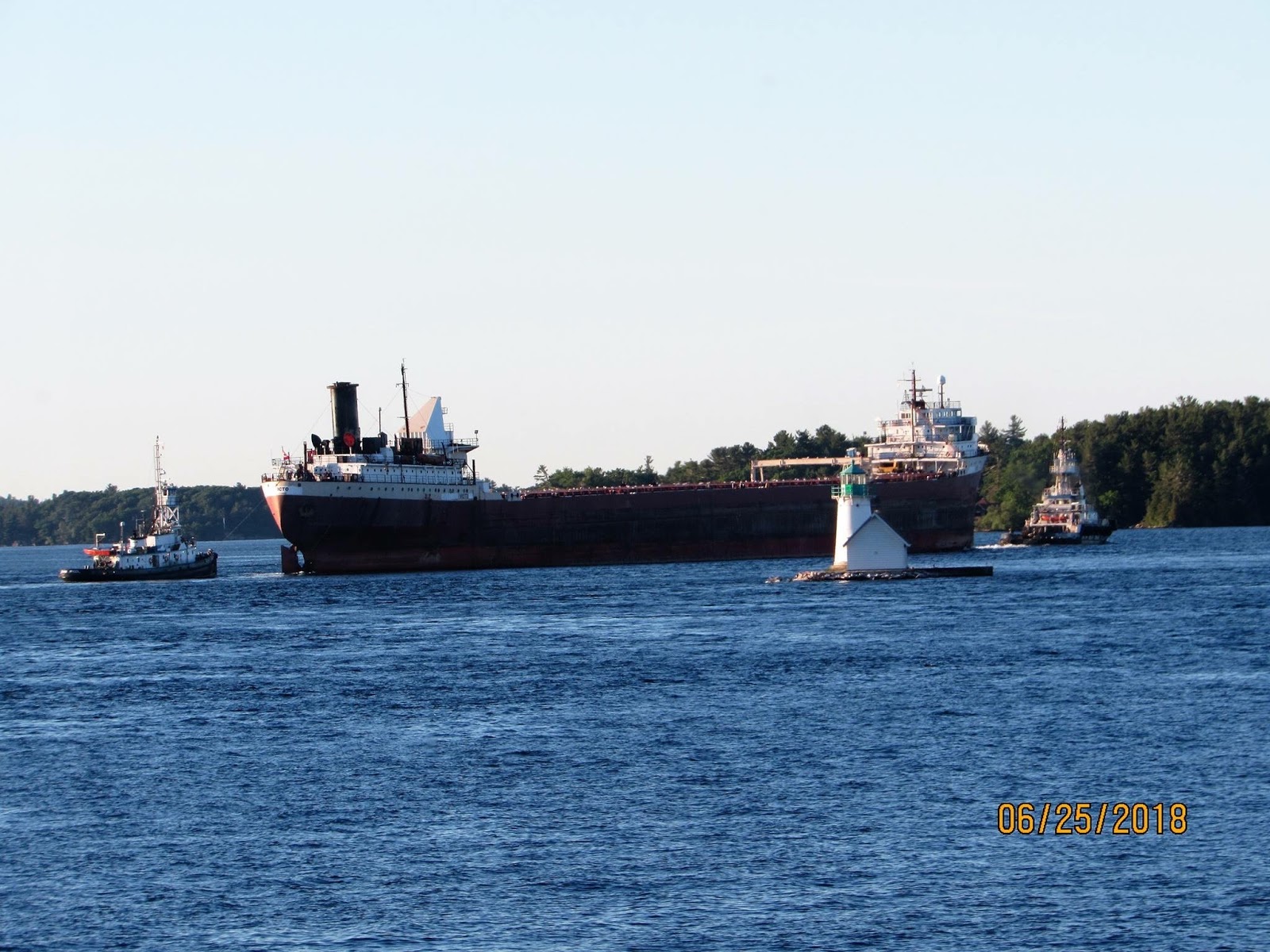
| The scrap tow and her escorts TIM McKEIL and EVANS McKEIL, glides by Sunken Rock Lighthouse at Alexandria Bay, NY - June 25, 2018. Photo by Kathy Badore |
 |
| Old Glory flutters proudly as preparation to remove the self unloading boom that had been added to the MIDDLETOWN 36 years earlier, began at Fraser Shipyards in Superior, WI in May. Photo by Bucky Harvey |
Fellow boat-watcher and new friend, Yvan Gingras's last photo of the
AMERICAN VICTORY as she waits to be lowered along with escort tug,
SEAHOUND, tucked beneath her stern at Cote-Ste.-Catherine Lock on June 27, 2018. Yvan was busy that day, track the scrap-tow's progress from above Beauharnois to Cote-Ste.-Catherine, the second last lock on the Seaway for the
VICTORY to transit. Check his very interesting videos when you have a moment:
Above Lock 4,
https://youtu.be/F02SAcsEKNs,
At the Mercier Bridge,
https://youtu.be/gxCBv4LJKYg,
Entering Lock 2 at Ste. Catherine,
https://youtu.be/JQvyqobdaVk
Thanks again Yvan 👍👍
Here's three great photos by Fred Miller II of the upbound
AMERICAN VICTORY at Port Huron on January 28, 2006. I know this section of the St. Clair River and I can almost hear her wake as the impressive prow of the former WWII fleet tanker pushes her way through a pretty strong current there while approaching the Blue Water Bridge. Thanks for sharing these memorable moments Fred.