Monday, 30 January 2017

Tug Boat CHARLIE E.


Along West Street's Port Promenade - November 19, 2015
Along West Street's Port Promenade - July 2, 2016
Hey, we just got back from Cuba where it was hot☀️, Hot๐ŸŒž, HOT ๐Ÿ˜Ž unlike here in the Great White North where it's not๐ŸŒฌ, Not๐ŸŒจ, NOT anywhere near hot especially this morning waking up to -17 Celsius with a chill ๐Ÿ’จ factor of -24. Brrrr๐Ÿ˜ฌ. When not playing with my grandsons, I was busy getting the laundry done, and shovelling SNOW ❄️๐Ÿ˜ณ❄️. It is what it is. So since I haven't published a boat story in a while, here's short post about a cute little boat that has caught my eye more than once when visiting Port Colborne, and a quick background about her interesting names or lack there of.
When she was built in 1943, she was given the name KOLBE, after her owner, W.F Kolbe of Port Dover, Ontario. Along with shipbuilding, W. F. Kolbe and Company which had expanded to Port Dover from Erie, Pennsylvania near the turn of the 20th century had a large fish and poultry processing plant located on the banks of the Lynn River and was the community's largest employer from 1908 to 1992. The 63' KOLBE was one of 11 fish tugs in the W.F. Kolbe fleet, which was one of largest on the Great Lakes during its day. According to the SOS-'Save Ontario Shipwrecks' Spring 1995 newsletter, one of Fred Kolbe's sons, Robert, was very inventive and was issued a patent for freezing equipment which was wildely used in the Great Lakes commercial fishing industry. Cool ๐Ÿ˜ eh!! The KOLBE continued to fish for the family business until 1951 when she was sold to Bill Siddall of Port Maitland. Apparently she was a pretty noisy boat according to an article written by Bill Warnick in The Dunnville Chronicle on October 10, 2001, where Bill says that when her engine was started at 5:30 a.m., "it seemed to rattle every weld in her and signalled that it was time for the residents of Port (Maitland) to awaken". Bill went on to say that in 1984 "the KOLBE was traded-in to John Van Halteren (owner of Dovercraft Marine in Port Dover) in partial payment to have John build the G.W. SIDDALL. Like the former fish tug EDITH GAULTIER (http://carlzboats.blogspot.ca/2015/11/mystery-boat-edith-gauthier.html) the KOLBE became a tender for a Toronto dive school and renamed LOIS T.
Nice one ๐Ÿ“ท Jeff!! Wish I had a boat ๐Ÿšค
Soon after she was sold to Nadro Marine, also of Port Dover and converted into a tugboat. Oh WOW, LOIS "T" sure looked pretty sharp in her Nadro black/red & white colours in this pic Jeff Cameron of St. Catharines caught of her on Lake Ontario in his boat approaching Port Weller on July 7, 2000.     
Taken from his boat, again, Jeff Cameron caught her tied off to former RCN tug RIVERTON waiting to be dismantled at Marine Recycling Corp.'s ship scrapyard in Port Colborne on August 17, 2015
With her hull still in Nadro colours, the name CHARLIE E
can clearly be seen in this Jeff Cameron pic (not from his boat) 
on January 19,2003. What's with all the snow & ice in Port Colborne, eh! 
Her name was changed to CHARLIE E. when she was sold to International Marine Salvage Inc. in 2002 and ever since, the small tug is used to berth or move various obsolete vessels at their recycling facility at the southern entrance to the Welland Canal in Port Colborne and their previous location at Port Maitland. Though always looking well maintained in any of the pics I've taken of her over the years, for whatever reason her owner has decided to the keep this beauty's identity virtually unknown. While most all other commercial and sometimes pleasure boats that I've snapped proudly has the vessel's name boldly displayed at the bow or at least above the port of registry at her stern, the only place I saw CHARLIE E.'s name was on a small plate above the hatchway door to the her wheelhouse.

Naming a ship is required for identifying and communicating with other ships while in transit, but I've seen nothing written in stone or in marine paint for that matter that indicates where the ship's name should be displayed on a boat.

Why the low profile identity for this environmental-friendly "green" hulled workhorse with a such a prestigious past is beyond me. Like I'm sure most boat watcher's would agree, it truly is odd looking but I guess it simply is what it is.
Tied of to former CCGS VERENDRYE and harbour tug TECHNO ST. LAURENT in this series of photos
- October 9, 2013
If any of my Great Lakes Fish Tug group friends has additional info about the nameless CHARLIE E. or photos of her when she was the KOLBE or LOIS T., please pass them my way so that I can update this post. I'll credit you, of course. And, if you're getting tired of counting snowflakes or laying rock salt on your laneways this winter, here's a couple links to some interesting articles that I found while researching CHARLIE E.
Capt. Gerry Ouderkirk's article about Robert Kolbe's fish tug, the ROBERT K. http://www.saveontarioshipwrecks.ca/sites/default/files/NLMar95.pdf
And, Bill Warnick's piece and other articles in the Winter 2014 issue of The Grand Dispatch: http://www.port-maitland.ca/dispatch/Vol%202-A%20Number%201%20Winter%202014%20.pdf
Enjoy!! ๐Ÿ˜Š
BTW, to view thousands of Great Lakes ship photos both modern and vintage, be sure to checkout http://www.greatlakesships.ca or http://www.oceanships.ca for photos of ships from elsewhere around the world. You'll be Glad You Did!!


Sunday, 8 January 2017

Self Unloader ALGOSOO (Last Voyage)

February 20, 2016
Winter is here!! Both on paper and very much visible as many of my FaceBook friends will testify who may from time to time check out another one of my time well wasted features, this one known as Carlz Back Deck SnowCam*. Yes, whether it was just a dusting like our first snowfall this year on October 27th (to the right), or a whomping 34 cm of the white stuff that had fallen to date in the December 22 pic (below), you can spend as much time as you wish checking out how much snow has accumulated around my empty Molson Canadian beer bottle with a Canada ๐Ÿ‡จ๐Ÿ‡ฆflag in it or my sometimes working solar-powered lighthouse. Do remember though, as per the (*) next to SnowCam*, it's just a picture. No, you don't want to be like one friend who said, "Carl, I've been looking at your snow-cam all day and nothing has moved!". Well, as I said to her, that's because like it says in the album's description, it's just a SNAPSHOT - NOT A LIVE CAMERA, okay?. Yes, she was pretty embarrassed and no, I'm not going mention her hair colour. But you probably guessed it. c):-()
Yes, winter in the Great White North can be such a blast especially when that "Polar Vortex" thing comes over the top from Russia ๐Ÿ‡ท๐Ÿ‡บ dropping already frigid conditions to temperature readings that whether you call it -40 Celsius or -40 Fahrenheit, it's the same thing, TOO DARN COLD!! ๐Ÿ˜ฌ
Combine all of the above with my doctor telling me the that my ongoing lower back pain is most likely caused by "DDD or Degenerative Disc Disorder", which apparently is just a normal change that will happen to us all as we AGE. c):-(( Hopefully whenever I get my MRI it will offer a better explanation but regardless it sure "SUCKS" when you start getting old, or entering the "winter" of your life.


February 20, 2016
Meanwhile, back at the boat blog, a little more than a year ago on December 30th, the 730'  ALGOSOO had made her way off Lake Ontario and positioned herself lakeward at Pier 35 in Toronto. Unlike she had done just over 40 years earlier when the spanking new Algoma Central self unloader delivered a record cargo of 26,351 metric tonnes of salt from Goderich, Ontario to Toronto, the big lady was about to start her 41st winter layup. While other Algoma fleetmates have been known to continue to haul road salt to U.S. harbours on lakes Michigan and Huron deep into January, a December 30th layup might have offered some crew mates the opportunity to bring in the new year at home with family or perhaps get an early start to a much appreciated vacation to a sun destination in the Dominican or Cuba. It had been a long season and while repairs to their "home away from home" would be completed by contractors during winter layup, their focus then would be directed at enjoying time with their family and friends, and thoughts of returning to ship life on the ALGOSOO would be in the back of minds for a good couple of months.

February 20, 2016
February 20, 2016
When the built at Collingwood Shipyard ALGOSOO went into service in December 1974, she would be the last traditional style straight-deck laker to be built on the Great Lakes with a pilothouse up forward at her bow. She had served her company well over the years but obviously she too had entered the winter of he life   because due to poor earnings resulting from stiff competition and declines in salt, grain and ore shipments, Algoma Central had other plans for the stern mounted self unloader as the ALGOSOO and five other dry bulk carriers including a  product tanker would be retired and dismantled in the  upcoming months.

February 20, 2016
Also doomed for disposal and wintering in Toronto at the Port Lands Channel was the 730' ALGOSTEEL (http://carlzboats.blogspot.ca/2013/09/self-unloader-algosteel.html) - February 20, 2016 
April 24, 2016
The day after I snapped the ALGOSOO sitting high in a now iceless Toronto harbour on April  24th, the New Orleans-like "Funeral Parade for other marked for disposal fleetmates began first with the ALGOMARINE departing Goderich under her own power and laden with road salt destined for the St. Lawrence river or Seaway ports of Johnstown, Ontario, and Valleyfield and Cote Ste-Catherine in Quebec during  her working final voyage to Montreal   (http://carlzboats.blogspot.ca/2016/05/final-voyage-1-self-unloader-algomarine.html).  After a long Atlantic and Mediterranean crossing, the then scrap-tow MARI arrived for dismantling at Aliaga, Turkey, just a few days after the NAVI, previously known as ALGOMA NAVIGATOR (http://carlzboats.blogspot.ca/2015/03/self-unloader-algoma-navigator.html). Then as if being played out like a planned mass execution scene from the movie, "The Godfather", the doomed oil and chemical tanker ALGOSAR  (http://carlzboats.blogspot.ca/2015/10/oil-chemical-tanker-algosar.html) proudly motored upbound on the Welland Canal to her final destination at the International Marine Salvage (IMS) scrapyard in Port Colborne, while the self unloader PETER R. CRESSWELL (http://carlzboats.blogspot.ca/2016/06/final-voyage-self-unloader-peter-r_27.html) limped her way downbound on one engine along the Welland Canal and Seaway to her rendezvous with the Turkey-bound scrap-tow tugs, all on the same day as the MARI was being towed out of Montreal. Coincidence, or WHAT? ๐Ÿ˜
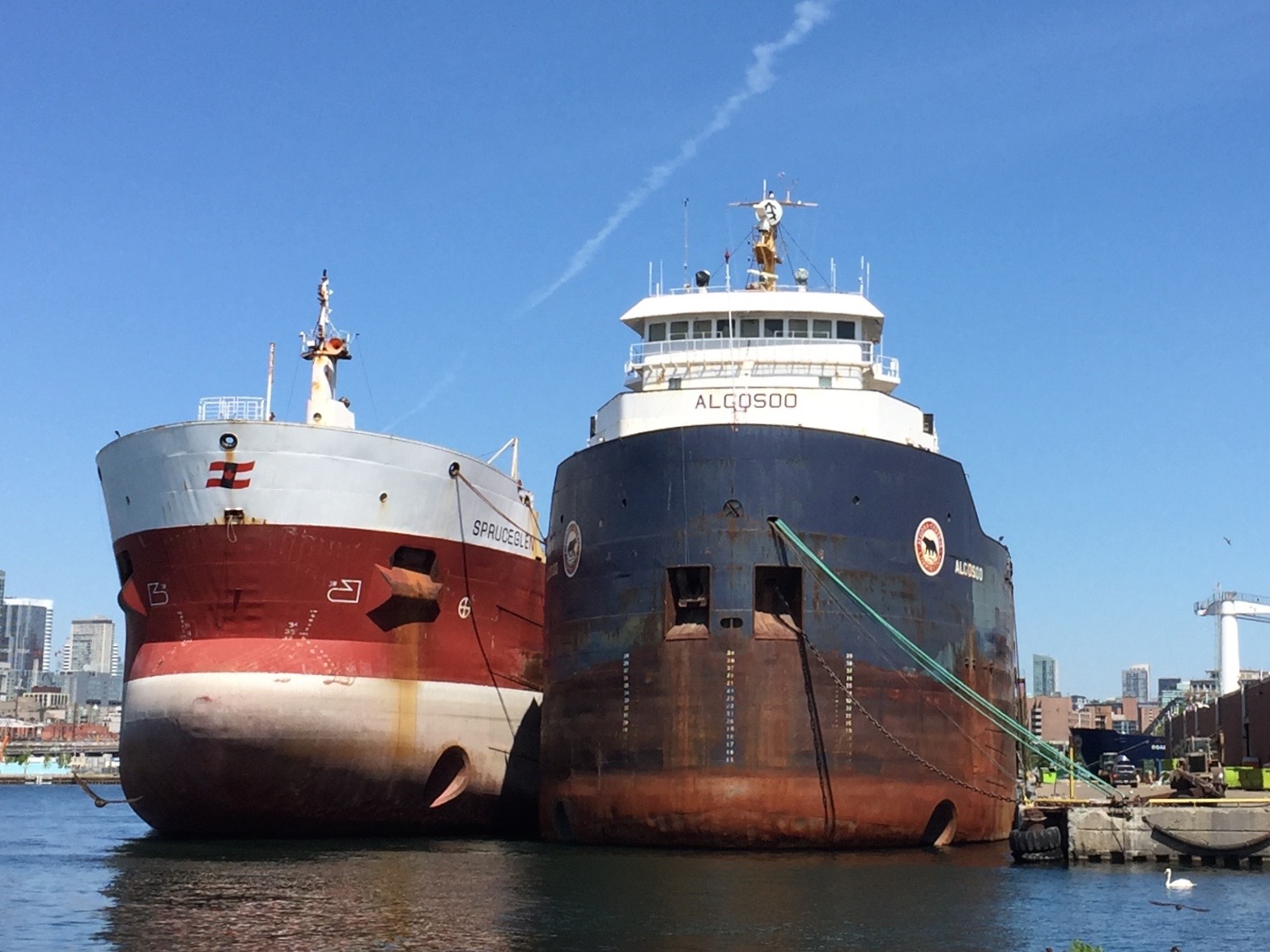
Hey, Budda Bing, Budda Bang!! Four down and the remain two continued their long term layup in the big smoke only now the 730' SPRUCEGLEN sat lashed off to the ALGOSOO for any undetermined stay due a lack of dry goods to carry.
That all changed for her and the other CSL gearless bulk carriers laid up in Montreal, and Thunder Bay as a bumper crop of prairie grain was announced and they all quickly got underway in late August in a big rush to move the surplus wheat and granola to St. Lawrence River elevators for pick up by salties to overseas markets. Also, the word got out that the upcoming winter was going to be a snowy one, and that additional supplies of road salt would need to be distributed to lake and river ports as soon as possible. To get the job done, not only was the idle in Sarnia ALGORAIL put back into service in mid September, but on August 26th, the waiting for dismantling, ALGOSTEEL got underway and remains active recently delivering salt to the Lake Michigan ports of Milwaukee and South Chicago.
June 4, 2016 
Arriving at Port Colborne. Photo by Nathan Attard

 Photo by Nathan Attard
Eventually ALGOSOO got underway too on October 2nd, though not to haul salt or iron ore like she was designed to do but instead to make the short passage across Lake Ontario to Port Weller and then the slow step by step climb up to the top of the Niagara Escarpment during her last voyage through every Welland Canal lock for last time, before arriving at her  final resting place  at the IMS scrapping dock in Port Colborne. Within days of her arrival, yard crews were seen by Nathan to be painting over her port of registry and namesake, Sault Ste. Marie, on her stern, and the Algoma brand "bear" logo on her stack. Over the years ALGOSOO was no stranger to Port Colborne. On April 5, 1982 she passed through Port Colborne's Lock 8 to be the first downbound laker of the new shipping season. During Port Colborne's 1999 Canal Days, the ALGOSOO sat proudly and open public tours as part of Algoma Central 100th Anniversary at a dock almost opposite to where she is being dismantled today.

Photo by Nathan Attard - October 14, 2016
Though blamed for a conveyor belt fire that also gutted the stern accommodation section of the ALGOSOO while laid up for winter in Port Colborne in March of 1986, you can see that there's currently been no stopping to the welder's torch as this last great classic laker to be built on the Great Lakes quickly becomes nothing more than a memory as seen in this series of photos taken by James Cameron and Nikki Thornton.  
Photo by Jeff Cameron - October 19, 2016

Photo by Jeff Cameron - November 6, 2016

Photo by Jeff Cameron - November 6, 2016

Photo by Jeff Cameron - November 13, 2016

Photo by Jeff Cameron - November 13, 2016

Photo by Jeff Cameron - November 13, 2016

Photo by Nikki Thornton - December 25, 2016
Photo by Shaun Vary - October 2016
Though Shaun Vary said his taken directly into the sun photo was not a great shot as his Lower Lakes Towing self unloader SAGINAW passed her by in October, I know it was a difficult one for him because the ALGOSOO was his first boat. At some point in his life Shaun left the SOO and went on to bigger and better things. It was his choice. For the past few years we're seeing Canadian shipowners replacing their aging fleet with state of the art and more fuel efficient vessels to remain competitive. It's a matter of survival. Though we all feel bad that another beauty is being dismantled abroad or on the lakes, at least the steel is being recycled. A greater concern maybe of what happens to the 20 or so crew members who are force out of work because their boat which as been there "home away from home" for extended periods of time is being scrapped. Al least 100 men and women sailors found themselves displaced from former Algoma ships alone last year. Until the new-builds arrive next season or later, perhaps some will find work by being recycled or rather, "rotated" on other Algoma ships or with other fleets. To make ends meets some may become short order cooks at a local dinner or McD's while others maybe entering "the winter of their life" and perhaps retiring to a beach in Florida or skipping a fish tug on Lake Erie may makes better sense when the axe falls. What will be, will be.

On a lighter note,
Happy ๐Ÿ˜Š New Year!!
Hey,  I don't know what it's like where you live but up here in the "Great White North" winter has returned big time. With the lack of snow that we received last year thanks seรฑor El Niรฑo, his distant cousin,  seรฑora La Niรฑa has returned the white stuff ❄️  ❄️ ❄️ threefold which has made for some great picturesque photo ops but very treacherous driving conditions for my current line of work as a transit bus ๐Ÿš operator in Ottawa ๐Ÿ‡จ๐Ÿ‡ฆ . I know, "What will be, will be". However, due to many ongoing yard work projects last spring, summer and fall, I wasn't able to blog as often or make it down to the River or Seaway to take my snaps so I really appreciate being able to use photos from other boat watchers like Nathan Attard, Jeff Cameron, Ted Wilush, Nikki Thornton, Brenda Benoit, and Joanne Crack. Along with their great photos I really appreciate the ongoing technical knowledge and life experiences from Ron Beaupre and Shaun Vary. Once again, Thanks and All The Best Wishes to You and My Readers in 2017. ๐Ÿ˜Š Carl Burkett

Wednesday, 30 November 2016

Self Unloader JOSEPH L. BLOCK

Photo by Nathan Attard 29.11.16
The Americans are Coming!!
No it has nothing to do with the actions of many U.S. residents who on the Presidential election night, overwhelmed the Canadian immigrations website so much with requests to move to Canada that it crashed the system almost immediately. No, again, this post is not about a surge of our neighbours to the south "getting out of Dodge" but instead the use of the Welland Canal and the other Canadian and American St. Lawrence Seaway locks and channels to get U.S. iron ore from mines in Minnesota and Michigan, down the St. Lawrence River to Quebec City where it will be loaded on huge Panamax-size bulk carriers and exported to Japan and China.

Photo by Nathan Attard 29.11.16
Photo Nathan Attard 29.11.16
As mentioned in a recent article in Boatnerd.com's 'News Channels' by the Chamber of Marine Commerce, many American 1000 footers have been transporting the ore to Conneault, Ohio, where it would be loaded then shipped down the St. Lawrence on Canadian self unloaders. However in this case, the 728' American self unloader JOSEPH L. BLOCK will be delivering her cargo of ore pellets from Two Harbours, Minnesota, directing to the Port of Quebec herself, and in doing so, passing through waters that apparently she's never transited before. c):-D
In this first series of impressive photos by "my man in Port Colborne", Nathan Attard captured the JOSEPH L. BLOCK tied off at Wharf 16 near the old coal dock apparently banking rays in the late afternoon sun while Seaway inspectors gave her the once over, a routine activity for first-time transits of the 44 km (28 mi) Welland Canal, (a.k.a. "the ditch") and Seaway system below Lake Ontario. Once cleared to get underway on her unusual voyage, Nathan also snapped the BLOCK as she passed beneath Bridge 21 and while continuing to make her way towards Lock 8. Great reflections there, Nathan!! c):-o
Photo by Nathan Attard 29.11.16
Though currently owned by Central Marine Logistics of Griffith, Indiana, the JOSEPH L. BLOCK was built in 1976 at Bay Shipbuilding in Sturgeon, Wisconsin for the Inland Steel Company of Chicago, Illinois and named after their former Chairman of the Board, Joseph Leopold Block. With a cargo capacity of 37,200 tons, the BLOCK was specifically built to trade iron ore from Escanaba, located along the south shore of Michigan's Upper Peninsula, to Inland's steel mills at the other end on Lake Michigan at Indiana Harbor (East Chicago), Indiana.

Once again, thanks my friend for the great pics. You da man, Nathan, You da MAN
Nathan with another American self unloader,  JOHN J. BOLAND in the background - 18.09.14

Sunday, 20 November 2016

Fish Tug COSLEY BROS


Hot diggety-dog, look at this big girl coming in from Lake Erie's Long Point Bay to unload her catch at Port Dover on September 20th. She's the 54' fish tug COSLEY BROS and instead of the usual white superstructure or house with a red, black or blue trim like one more often might see painted on  a Great Lakes fish tug, COSLEY BROS is almost completely ORANGE above her waterline. Don't get me wrong because orange works for so many things like pylons, and freefall lifeboats like you see at the back of all salties or tankers, or even the hard-shelled inflatable life-raft canister that's secured just beyond the COSLEY BROS's pilothouse amidships. Orange is a great colour because it stands out perfectly in daylight or in a light beam, in rough dark seas or even calm ones like when the proud fish tug gracefully made her way past Port Dover's harbour piers. Named for owner Frank Cosley's two sons, Pete and Paul, the then Port Dover based COSLEY BROS  was built in 1949 at Stephen G. Powell's shipyard near Royal Canadian Air Force Station Dunnville along the Grand River half way between the town of Dunnville and Port Maitland. No. 6 Service Flying Training School, as it was known during the Second World War British Commonwealth Air Training Plan was one of several air bases located along the Lake Erie shoreline and Southern Ontario which trained pilots advanced techniques to prepare them for wartime action overseas or for duty in RCAF Home Defence squadrons. Before the airfield was sold off in 1964, it had been used as a repair depot for RCAF base Trenton (on Lake Ontario). During Sunday drives to Dunnville or along the Grand River, I still recall seeing Lancaster bombers and other aircraft that had been stored or "mothballed" there near the runway. Now that was really cool!! c):-o

Meanwhile, back to the boat blog, soon after being built, the Cosley brothers took over the business from their dad and the fish tug which was then painted red to the top of the bulwarks and her house was silver. Kind of like an airstream trailer that floated, or NOT!! c):-)

Anyhow, in 1977 the Cosley brothers sold the COSLEY BROS to the Weaver brothers of Port Stanley. While the name was kept, her hull was painted black and her house remained silver. Then for a time she was grey and while being rebuilt in the early 2000's, she was coated with an orange primer. After a while, her owners got to like the new colour scheme which is why the COSLEY BROS remains orange to this day. Hey, here's another benefit of being painted orange, it hides the rust real good!! (Got that: Algoma Central).

Nice snaps above of the COSLEY BROS approaching Port Dover's twin bascule hydraulic lift bridge eh? Well actually the big orange fish tug had already motored passed the up reaching spans that actually opened for the first time in 1971, but because she couldn't turn around in narrow Lynn River channel beyond, her skipper had no choice but to slowly run her astern beneath the bridge to get back to the outer harbour and the fish processing plants.
All that in your face fish tug action sure can make you hungry and boy were we surprised to see that Arbor's  Foot-Long Hot Dog stand was still in town. Back when my better half, Janny was growing up in Ancaster, Ontario, near Hamilton, her parents would drive down to Port Dover and stop into Arbor's, which has been in business for 85 years, for their foot long hot dogs, just like my parents did when we visited Port Dover when I was a kid. How neat is that, eh?
My Arbor's foot-longer was smothered in ketchup, mustard, relish and onions while Janny's was just mustard, jalapenos, and a sprinkling of hot peppers that were red, yellow and of course, ORANGE!! c);-b

Thanks again Shaun Vary for your input and a special thank you to Betty Powell, who's  late night Facebook comments were greatly appreciated. c):-D


Sunday, 6 November 2016

Saltie-Laker SELKIRK SETTLER

Misener Transportation Postcard of SELKIRK SETTLER - Photographer Unknown
Whenever I have a moment I'm either reading or listening to a murder mystery book and whether it's Michael Connelly's Harry Bosch, or J.A. Jance's J.P. Beaumont or Louise Penny's Chief Inspector Armand Gomache, the author at some point in the novel will have their homicide cop character say, "there's no such thing as a coincidence".
It may have appeared as a normal everyday sail past below Iroquois Locks on August 14, 2014 when I snapped the SPRUCEGLEN as she motored upbound in ballast on her way  to Thunder Bay to pick up a load of grain while the fully loaded straightdeck OJIBWAY  motored  downbound to discharge her cargo of grain in Sorel, Quebec. What's unusual though is when the current CSL owned sternender was launched at Govan Shipyards in Glasgow, Scotland in 1983, she was known as the SELKIRK SETTLER. If you're interested in Canadian history, as I am, you will know it was a very important name as it acknowledged the enduring efforts of a group Scottish immigrants that came to Canada in 1812 via Hudson's Bay to settle in the Red River Valley which is north of current day, Winnipeg, Manitoba.
Their two month crossing of the Atlantic Ocean and Hudson's Bay, and then paddling the swift rivers against the current was both long and strenuous for these future wheat farmers. To make matters worse, when arriving at their final destination in August 1812, their promised new settlements had not been completed and since the planting season had ended, the first group of European "SELKIRK SETTLERS" may not have survived their first winter had they not been taken in by the aboriginal Saulteaux band which were descendants of the "OJIBWAY" First Nations Peoples. Coincidence or WHAT c):-()
Whether considered a coincidence or NOT, the uniqueness here is the selection of names Misener Transportation of St. Catharines chose for their new class of gearless bulk carriers or "Saltie-Lakers" which were specifically designed to haul prairie grain to the lower St. Lawrence River grain elevators in such ports like Sorel, Quebec City and Baie Comeau while the Seaway was opened, and during the winter months, transport the grain and other products products to various overseas ports in Europe, Russia and along the Mediterranean.  After the SELKIRK SETTLER came the CANADA MARQUIS (http://carlzboats.blogspot.ca/2013/09/saltie-laker-canada-marquis.html) named after a specially designed grain that when it was introduced in 1911 it became known then and still today as "the best wheat variety in Canada". This high quality wheat that when baked gives the loafs more volume is grown throughout the country and continues to be exported all over the world.
The third sister which sailed under the Pioneer Shipping banner and red/orange coloured hull, was named SASKATCHEWAN PIONEER for the many different nationalities from around the world who immigrated to Canada and settled in what is now known as Saskatchewan from 1870 to 1930 and who transformed the "the last of the west" into the "world's granary". c):-o

As Skip Gillham said in his 1989 publication of "Canadian Fleets Along The Seaway" - "These ships have carried grain to Cyprus, USSR, Morocco, and England. They have taken potash to France and Belgium and returned from Europe with steel for the Great Lakes...they handled winter navigation on the Baltic moving European grain from Hamburg, West Germany to Leningrad. They were now able to get a year round return on their investment instead of the ice shortened nine months on the lakes."  While it appeared things were looking up for Misener's saltie-lakers, Canada's grain exports via the Great Lakes and Seaway continued to decline during the late 80's. To cut costs, the country of registry for SELKIRK SETTLER was changed to Isle of Man in 1987. The same occurred soon after for her other saltie-laker sisters and instead of a proud Canadian flag flying from their sterns, they all flew the flag of the Isle of Man, a small island in the Irish Sea. Then in 1991 both the SELKIRK SETTLER and CANADA MARQUIS were sold to Federal Navigations of Montreal and while being owner or under charter with Fednav, their names were changed several times and flew a variety of other flags of convenience.
The once proud bulker named for Canada's first prairie wheat farmers was named FEDERAL ST. LOUIS and flew the flag of the Bahamas when owned by Fednav's Detroit, Antwerp and London divisions in 1991. In the following year, she was changed to FEDERAL FRASER and flew the flag of the Philippines, Hong Kong and Panama as the ocean trader which still visited the Great Lakes regularly, continued to be sold off from one southeast Asian owner to another while still operating under a long term charter with Fednav. In 2001 her name was changed again to simply FRASER, a name she continued to bear when purchased by Canada Steamship Lines in October of 2002.
Reflagged Canadian, the FRASER arrived at Quebec City in December 10th and not before leaving the next day with a load of sugar for Redpath's in Toronto, the bulk carrier was re-registered Canadian and named SPRUCEGLEN.
Two months later, her former  saltie-laker sister CANADA MARQUIS which then sailed as the MACKENZIE, was purchased from Fednav and renamed BIRCHGLEN (http://carlzboats.blogspot.ca/2012/08/saltie-laker-birchglen.html). Both vessels followed CSL's naming pattern for their gearless bulk carriers like the PINEGLEN and CEDARGLEN with tree motif prefix reflecting back to CSL's 1937 acquisition of Tree Line Navigation Company and their 1926 purchase of the Great Lakes Shipping Company which included the suffix "GLEN" in their name.
Like when she arrived for her first winter layup in Toronto in December 2002, SPRUCEGLEN was probably laden with sugar when I snapped her sitting low in the water at Toronto harbour's berth 514 first last February and then again in April (both snaps above). However when I captured her again in June (below), she was sitting high in ballast and tied off to the Algoma self unloader ALGOSOO at the Section 35 dock. It's a mystery? c);-b

Though SPRUCEGLEN initially continued to operate deepsea during the winter months like she had done as the Misener saltie-laker, SELKIRK SETTLER, more recently her winter layups have extended well beyond the opening of the shipping season and the St. Lawrence Seaway in the spring. Actually such was the case again this year for all of CSL's other dry bulk carrying "GLEN's". Each laying in wait for work to come along in Thunder Bay and Montreal which is a far cry better than motoring to Turkey for dismantling which was the case for fleetmates  MAPLEGLEN and BIRCHGLEN (the former CANADA MARQUIS) in September 2015. c):-((
Being cut apart by a breaker's touch will just have to wait little longer as the SPRUCEGLEN and her remaining saltie-laker fleetmates (CEDARGLEN, PINEGLEN, and OAKGLEN) all got underway in later August to haul another bumper crop of prairie grain to lower St. Lawrence River elevators just like they were designed to do many years earlier. c):-D
As for the ALGOSOO? Well, that's another story and it will to be told soon in an upcoming Carlz Boats. c):-((

KAMINISTIQUA at Port of Johnstown - April 23, 2016. Her story:
https://carlzboats.blogspot.com/2012/07/salty-laker-kaministigua.html
UPDATE: January 3, 2020: The BIRCHGLEN or former CANADA MARQUIS continued to move grain from the Lakehead to the Lover St. Lawrence River terminals until 2015 when she was towed to Turkey for dismantling, however the third Misener "Saltie-laker" SASKATCHEWAN PIONEER is currently operating for Lower Lakes Towing as the KAMINISTIQUA and is wintering at Port Weller Dry Dock while having her bottom repaired from a grounding near Beauharnois by Hamilton's Heddle Marine.
Downbound at Iroquois Lock - May 19, 2013. About my first rendezvous with the BIRCHGLEN check out:
https://carlzboats.blogspot.com/2012/08/saltie-laker-birchglen.html

Here's a couple nice pics taken by Jeff Cameron of St. Catharines in 1991 of the upbound former SELKIRK SETTLER, and then named FEDERAL ST. LOUIS passing beneath the Garden City Skyway while approaching Lock 3. Proudly displaying the large red "F" and partial maple leaf  ๐Ÿemblem on her stack that hull colour was still Misener Transportation "Blue" instead of "red" like all other FedNav bulk carriers that we see along the St. Lawrence Seaway and Great Lakes. Thank You Jeff. Great photos as always. ๐Ÿ‘๐Ÿ“ท๐Ÿ‘