Monday, 25 August 2014

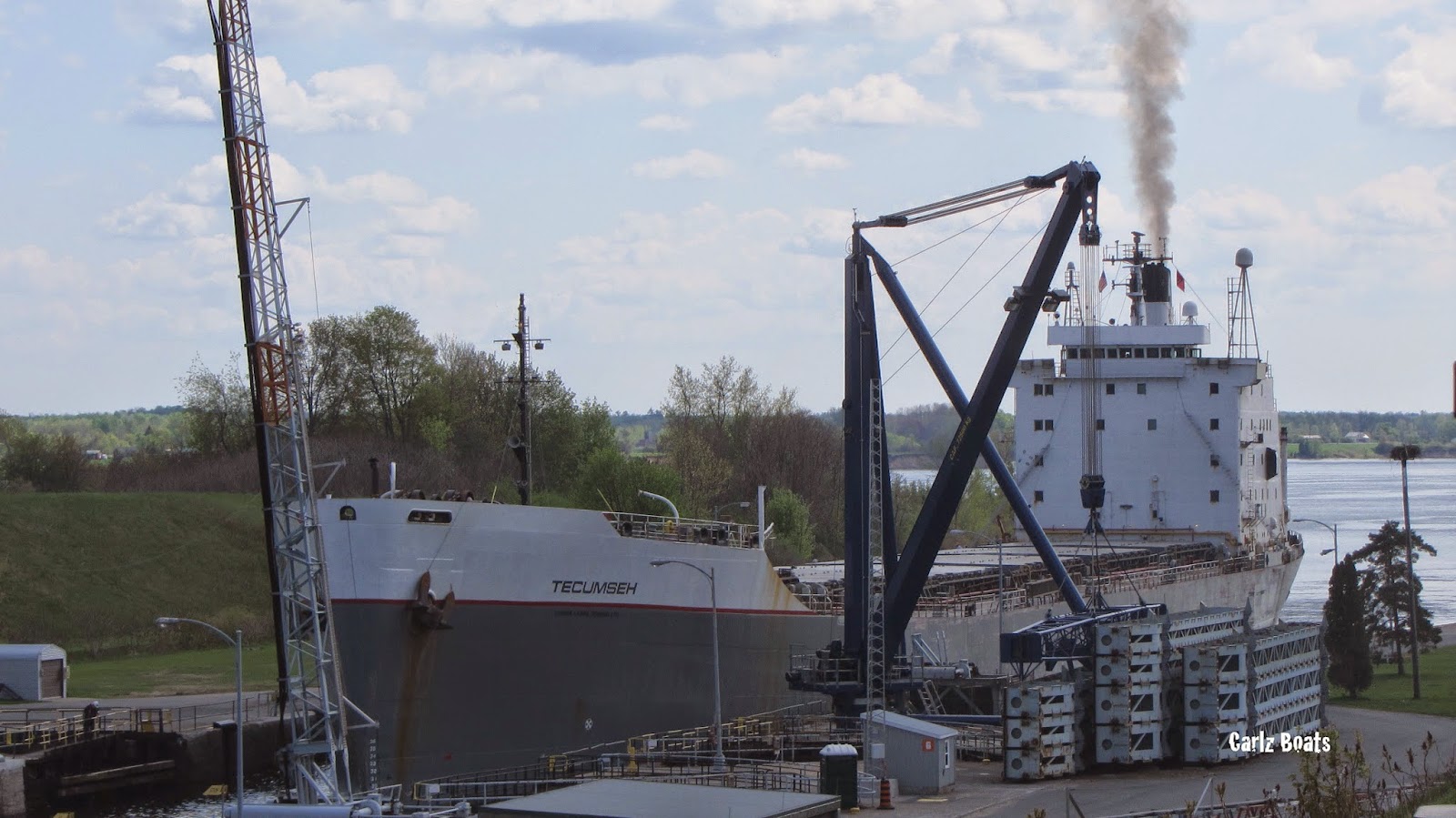
Bulk Carrier TECUMSEH

You've got to love the name selection for Lower Lakes Towing's fleet where all ships, with the exception of one, is named after First Nations leaders, their peoples or their unique translations. Like the classic straight-deck bulk carrier MANITOBA which like the Canadian province is named after what the Ojibwa people called 'Manidoobaa' meaning "Straits of Manitou, the Great Spirit" referring to the narrow channel at the centre of Lake Manitoba. The name of Lower Lakes bulk carrier KAMINISTIQUA (http://carlzboats.blogspot.ca/2012/07/salty-laker-kaministigua.html) is Ojibwa for 'river with islands', or their self unloader SAGINAW means "where the 'Sauk' peoples lived" in Eastern Michigan (http://carlzboats.blogspot.ca/2012/09/self-unloader-saginaw.html). Other Aboriginal named Lower Lakes ships include CUYAHOGA, MISSISSAUGI, MANISTEE, MANITOWOC and MICHIPICOTEN.
However, the ship name that I like the best is on their 641' bulk carrier TECUMSEH. Tecumseh was leader of the Shawnees and though he was born in Ohio, he became an ally of the British during the War of 1812. Tecumseh is honoured in Canada as a hero and military commander who played a major role in Canada's successful repulsion of an American invasion in the War of 1812. Chief Tecumseh was killed in the Battle of Thames near current Chatham, Ontario on October 5, 1813.

When the ship TECUMSEH was built at the Lockheed Shipbuilding yards in Seattle, Washington in 1973, her name was SUGAR ISLANDER and she was the largest American bulk carrier ever built to date. Her name was ideal because the SUGAR ISLANDER's primary task was to transport raw sugar from Hawaii to California. Later her name was changed to ISLANDER, JUDY LITRICO and then TINA LITRICO when she was purchased by Lower Lakes Towing Ltd. of Port Dover, Ontario in 2011. The gross tonnage for the TECUMSEH is 18,049 tons and she can carry a variety of dry bulk cargoes including grain, salt and iron ore. Her homeport is Nanticoke which in Delaware means "winding" creek, which incidentally is what makes Lower Lakes ships unique as they are smaller and able to maneuver shallower lake ports and winding rivers like the Cuyahoga, which in Iroquois means "crooked' river. There's a meaning for everything, eh!! c);-b      

Sunday, 17 August 2014

Heavy Lift Cargo Ship HHL CONGO (Revisited)

The first time I came across the upbound 453' HHL CONGO in July 2012, she was hauling a load of wind turbine towers across Lake St. Francis near Lancaster, Ontario. http://carlzboats.blogspot.ca/2012/07/cargo-ship-hhl-congo.html
On that day I didn't have my monopod to to help keep my little brownie steady when zooming in the far distant CONGO. Though it was getting dark fast, it was a easier snapping her last Thursday night as she approached and then transited Iroquois Lock on her way to Muskegon, Michigan. Instead of towers, this time it was turbine blades that were stacked high on her deck.      

When lauched in 2011 in Wuhu, Japan her name was BELUGA FEALTY. Later that year, she was purchased by Hansa Heavy Lift of Hamburg, Germany and  flies the flag of Antigua & Barbuda. Other HHLs that have frequented the Great Lakes includes the MISSISSIPPI, NILE, AMUR and the AMAZON which I snapped motoring downbound at near Mariatown on Labour Day 2012. Check it out: http://carlzboats.blogspot.ca/2012/11/cargo-ship-hhl-amazon.html 

Bulk Carrier FRITZ


Apparently the FRITZ is no longer "on the fritz", or is it? The FRITZ was built in China in 2012, and everything appeared normal for the 622' bulk carrier when she passed Gibraltar on May 29th with her 18 tonne cargo of steel rods destined for Toledo, Ohio. Again no problems were known when she entered the St. Lawrence Seaway's St. Lambert Lock on June 9th but on the next day, the FRITZ dropped anchor in the Seaway channel just west of Upper Canada Village near Morrisburg, Ontario (where I snapped these photos on Canada Day) and remained there for a month.
Initially it was reported that the reason for the FRITZ's unscheduled anchorage was due to engine problems. However as days passed it also became known that the crew's morale was also "on the fritz" as they had not been paid for over three month and the ship was running low on supplies of fresh food and drinking water. Meanwhile, residents on both sides of the border began complaining about the extended stay of the badly rusting eyesore in their front yards with its ongoing loud noises and bellowing smoke from the funnel. Finally the FRITZ got underway and arrived at Oshawa, on July 9 where financial woes continued for the ship owner, Intersee of Haren Ems, Germany, and for the striking crew who were heard pleading for equipment from with local fisherman so that they could catch Lake Ontario fish to survive. Eventually a new investor provided funds to allow the FRITZ to be moved to Hamilton to repair its still "on the fritz" engine while an Oshawa area Romanian church provided fresh food for the crew who were mostly from Russia and Romania though the ship flies the flag of Liberia.
With a repaired engine and somewhat happier crew, the FRITZ finally arrived in Toledo on August 9th, and thereby actually taking about two months to complete a journey that should have normally taken a only a few days once entering the St. Lawrence Seaway. Though her cargo was finally delivered, the FRITZ's future is still somewhat "on the fritz" as the "Made in China" rust bucket has been detained in Toledo indefinitely. "Pan-fried Lake Erie Perch, anyone??" YUMMY!! c);-b  


Wednesday, 6 August 2014

RO/RO Carriers CAPE KENNEDY & CAPE KNOX

"Roll On, or Roll Off, Rolling on the River". Sorry CCR for botching up your great classic rock song "Proud Mary", but when I saw these two huge grey ladies parked side-by-side along the wide Mississippi River in New Orleans last May, I first thought, "Ooo-Ooo, Navy Ships, my favourite" and knew we had to get ourselves on the paddle-wheeler NATCHEZ http://carlzboats.blogspot.ca/2014/05/steamboat-natchez_15.html (shown in this top snap) to check these girls out while we were "Rolling on the River".
But as we got closer, I could see that they weren't really navy oilers as anticipated, but instead two Roll On/Roll Off vehicle carriers, the CAPE KENNEDY (T-AKR-5083) and CAPE KNOX (T-AKR-5082) which both are operated by the US Navy's Sealift Command. Just like the snap shows as we approached them downriver, they are virtually twin sisters. They are both 696' long by 106' wide with a draft of 35' and have a top speed is 16.6 knots. They were also built at the same shipyard in Japan for Nedlloyd Lijnen of the Netherlands. The CAPE KENNEDY was launched as the NEDLLOYD ROSAIRIO in 1979 while CAPE KNOX was launched as the NEDLLOYD ROUEN a year earlier. In 1995 both vessels were purchased by the US Maritime Administration and placed on the National Defence Ready Reserve Fleet (RRF) and managed by Keystone Shipping in New Orleans. Currently there are 44 ships in the Ready Reserve Fleet docked in various ports along America's coastline, and 27 of the ships are RO/RO vehicle carriers.

Both CAPE KENNEDY and CAPE KNOX have side and stern ramps (the KNOX's stern ramp is lowered to the dock in my snap to the left) which enables wheeled cargoes to be driven on or off for loading and discharging much faster than conventional ships. Each also have 155,000 square feet of deck space on three cargo decks connected with ramps to move all sorts of military vehicles and aircraft. On their open deck, they can carry 1,550 containers or oversized military cargoes. Manned with a civilian crew, RRF ships take only 5 days to be activated and provide prompt sealift support in any event that they are needed which may also include peacekeeping or humanitarian response missions like during the aftermath of Haiti earthquakes.
Meanwhile, it's lay and wait time in the "Big Easy" for the sisters CAPE KENNEDY and CAPE KNOX until a need arises and so that they too will be "Rolling on the River" and showing their worth once again. c);-b 

Thursday, 31 July 2014

Self Unloading Crane Ship YANKCANUCK (Final Chapter)

Today my Dad would have turned 88 and like so many good people, he died too young almost 23 years ago. He was a farm boy who became a sailor, and then while working on the Welland Canal, he operated bridges, and locks, and when he retired, he was a lockmaster for Lock 8 which along with making certain ships transited the longest lock on the Seaway without issue, he got to operate a really neat motorized cart which allowed him immediate access of the complete length of the lock, as well as a fun ride with Grandpa during a visit home to Port Colborne. What was really neat while growing up was that my Dad seemed to have first hand knowledge of when a special boat was coming through like the tall ship CHRISTIAN RADICH, or a navy ship like the Canadian destroyer with a Sea King helicopter on board, HMCS FRASER, http://carlzboats.blogspot.ca/2012/05/hmcs-fraser-port-colborne.html, or the ship that we found by accident during our visit to the Soo last September, the self unloading crane ship YANKCANUCK.  
Though she looked pretty rough tied off to the Purvis Marine dock in Sault Ste. Marie, Ontario, I recall a much different appearance when seeing her for the first time as a kid tied up to the Algoma furnace plant wall with her bold black and white hull, a massive crane amidships and her yellow stack with two crossed flags: America's "Stars and Stripes" and Canada's flag then, the "Red Ensign". I even recall my Dad telling me that the reason why she had this unusual name was because the shipowner, (Captain John Manzzutti) was a Canadian and his wife, (Eleanor Cox) was an American, hence naming of his shipping company and this cargo ship with a crane the  "YANKCANUCK".
When launched in 1963 at Collingwood Shipyards, the 324' YANKCANUCK was the most modern vessel in company fleet which consisted of two small canallers, the MANZZUTTI and MANCOX. Like her smaller sisters, the YANKCANUCK was also equipped with a crane and was designed specifically to haul finished steel products between the Algoma Steel plant in Sault Ste. Marie and the Windsor/Detroit market. She was also known to move product throughout the upper lakes and frequented Port Colborne where Algoma also had a mill there. Since she had an ice-strengthen bow, the YANKCANUCK opened a new sailing season at the Soo on March 19, 1964. That was the earliest date ever then, though it's a regular occurrence these day with perhaps the exception being 'this" year thanks to that nasty @#%&! 'Polar Vortex' c):-o. Though she was sold to the Algoma Steel Corporation in 1970, it was business as usual for the versatile  YANKCANUCK as shipments were also sent up the St. Lawrence to Montreal and Port Cartier and then returning home with iron ore from Sept Iles, Quebec. Her powerful and movable crane came in handy more than once to lighten grounded ships and then reload them in deeper water. It was also used to transfer steel to salties in deep water anchorage in the Gulf of St. Lawrence and when owned by Purvis Marine, it was used to load and discharge cargo in the Arctic and outports along the Newfoundland and Labrador coastline.
She returned to the Soo in 2008 and has been laid up at the Purvis Marine and Salvage dock ever since. However, despite her grim and tattered appearance, her presence suggests that her potential value to be used once again to move cargo is far greater than having her cut up as scrap. Regardless of her state, I enjoyed seeing her again and I know my father would have too. Happy Birthday Dad, we miss you c);-))

Update - November 20, 2016:

I couldn't believe my eye. I thought she was gone years ago and there while driving along the harbour front at Sault Ste. Marie, Ontario on September 17, 2013 was a familiar object, the old ore carrier, YANKCANUCK. As the sun was setting I quickly got this shot of her on my iPhone. It's definitely not my best pic but it was my first of her, a ship that in the past was only a visual memory. 
However from now on it will be my photos in this post that will be my memory as the grand lady YANKCANUCK took her final voyage behind the line of fleetmate tug W.I. SCOTT PURVIS for dismantling just up the St. Mary's to the Purvis scrapping facilities last Friday on November 18, 2016. Like so many other "Great" lakers, she too will soon be gone, but also not forgotten.  

Sunday, 27 July 2014

Straight-decker ALGOMA MONTREALAIS (Final Voyage)


There's just no stopping her. Her life has been rejuvinated. When the shipping season ended last December, the MONTREALAIS, which is French for "Montrealer", berthed for winter in Montreal, the city where this traditional straightdeck bulk carrier was built in 1962. Everyone who's been tracking ships along the Great Lakes, were certain her sailing days were over, that she'd be towed overseas and scrapped like so many other Papachristidis and Upper Lakes Steamship's "Canadian-named" classics. While other uniquely designed 'Great Lakes' straightdecker with their wheelhouse and accommodations forward, have been repowered to diesel to extended their life, ALGOMA MONTREALAIS remained a steamer.
Then the worst winter in 35 years arrived which virtually halted normal winter and spring ship movement due to thicker than normal ice conditions west of Port Colborne. Shipments of iron ore, grain and other essential cargoes became delayed by over a month and despite the extra costs to operate a "steamer", it was ALGOMA MONTREALAIS size and just under 29,000 ton cargo capacity that extended her life and usefulness once again when she set sail on June 29 destined to Superior, Wisconsin to pick up a load of iron ore (http://carlzboats.blogspot.ca/2014/07/straightdecker-algoma-montrealais.html).

In less than 30 days, ALGOMA MONTREALAIS has been doing what she does best, move cargo like talconite iron ore pellets to a Hamilton, Ontario steel mill, then carried a load of cement back up to Duluth, Minnesota and now she's laden with a load of grain destined for the overseas grain elevators in Baie Comeau, Quebec. Since her late season departure, the MONTREALAIS has become somewhat of a media event as Boatnerds everywhere have been actively tracking and snapping her movement in Superior/Duluth, the Soo, Port Huron, and Welland Canal. I final got a chance to snap her last Thursday night as she glided downbound beneath the International Bridge near Prescott, then past pleasure crafts and the corn starch plant in Cardinal, and finally transiting Iroquois Lock way past my bedtime. Where ALGOMA MONTREALAIS will be heading next? Who knows, but boat-crazies like myself will keep you posted again, and again... c);-b

As new fuel efficient Equinox-class bulk carriers came into service, the extended life of the original Papachristidis classic straightdecker came to an end in May 2015, when she was renamed MONT, and scrap-towed to Turkey where she was dismantled. Gone but not forgotten. c):-(

Monday, 14 July 2014

Search & Rescue Lifeboat CCGS CAPE MERCY


Winter returns on paper at least, in just 5 months and 1 week on December 21st, or like last year, maybe even sooner. YIKES!! But regardless the big question is, whether weather conditions will return to normal levels of winter harshness or are we all destined to experience another Polar Vortex driven, "WINTER FROM HELL!!"? It sure was a doozy, eh? It also begs you to wonder, was the worst winter in 35 years an 'Act of God' or 'Mother Nature's' doing, or was it a result of man's multiple years of environmental abuse causing one more Global Warming induced 'Extreme Weather Event'. Regardless of who or what is to blame for the delays in winter and spring cargo movement, shipping associations on both sides of the border are already talking about what went wrong and what needs to be done if another "WINTER FROM HELL!!" returns more sooner than later. Good luck with that boys & girls because unless someone at the meeting is psychic or has in their possession a crystal ball, who can predict for certain what the weather will really be like tomorrow, not to mention nearly 6 month from now.
The Great Lakes normal ice breaking resources provided by the American and Canadian coast guards performed admirably but they weren't enough. Fortunately once the St. Lawrence Seaway opened in late March, Canada was able to send in two heavy polar-class icebreakers, the CCGS PIERRE RADISSON (shown at the top and snapped by Ron Beaupre as she passed his place in Mariatown, Ontario) and CCGS DES GROSELLIERS, along with the heavy endurance breaker, CCGS MARTHA J. BLACK (snapped by my friend Nathan Attard in Port Colborne http://carlzboats.blogspot.ca/2014/04/light-icebreaker-ccgs-martha-l-black.html).      
With icebergs still floating around in Lakes Superior in June, it maybe easy as usual to 'Blame Canada' for the colder that normal winter temperatures, but perhaps fleet owners may want to reconsider the design of their ships because while many long and lumbering rounded-bow thousand footers sat mired in the spring ice on the lakes and St. Mary's River channel crying "Help Me"!!, it was traditional pilothouse and accommodations forward lakers like the ALGOSTEEL (snapped leaving Welland Canals Lock 3 last summer by my Kanata friend Shaun), that seemed to motor through the brash with minimal ice breaking assistance. Go figure c):-o
Though perhaps arriving later than usual, summer has definitely returned and whether weather conditions or some mechanical issue causes commercial and private-user boaters to cry "HELP", first responders maybe Canadian Coast Guard search and rescue lifeboats like CCGS CAPE MERCY which I snapped last fall in Cobourg, Ontario on the north shore of Lake Ontario. The 48' MERCY which was built in 2001 at Metal Craft Marine of Kingston, Ontario and is one of 36 self-righting motor lifeboats that have entered service since 1997. Staffed with a crew of four including two rescue specialist, the Cape-class motor lifeboats have a range of 100 nautical miles and can reach a top speed of 25 knots. Based on a US Coast Guard design, there are 10 Cape-class boats on the Great Lakes and all stationed along Ontario's shorelines in Thunder Bay, Tobermory, Goderich,  Sarnia, Amhearstburg, Port Dover, Port Weller, Burlington, Cobourg, and Kingston. Regardless of the marine distress, the coast guard's motor lifeboats like the CAPE MERCY and local volunteer auxiliaries offers a fast and professional search & rescue service. For proof, check out this youtube link: http://youtu.be/T1bJkjBpmNM Cool eh!! c);-b