Friday, 11 October 2013

Oil/Chemical Tanker SLOMAN HERMES


A little bit of fog was still hanging around yesterday morning as I snapped the 476' upbound oil/chemical tanker SLOMAN HERMES making her way to an empty Lock 3 on the Welland Canal really 'slow', man (pun intended). Just ahead of her though are the St. Catharines 'Garden City Skyway' and the Bridge #4 or formerly known when I was a kid as the Homer Bridge. In 1939, the Queen Elizabeth Way (QEW), Canada's first four-lane divided highway which runs from Toronto to Fort Erie, Ontario was opened and at the time the double-leaf rolling lift bridge in then Homer, Ontario managed the traffic adequately.
I suppose it was probably quite a nice drive back then but apparently as the population increased during the post World War II boom in the 1950's, so did automobile and truck traffic, and before long massive traffic bottle necks were created as hundreds of cars and trucks waited twenty minutes or more far too often for a ship to pass by. In 1963, the Garden City (St. Catharines' moniker) Skyway was opened which allowed traffic to make the 90 mile or so journey from Toronto to Niagara Falls, or Buffalo, New York via the Peace Bridge, more freely and faster, at least until the Ontario Provincial Police (OPP) became equipped with unmarked cruisers and radar guns. YIKES!! c):-(

Meanwhile back at the blog, the high in the water SLOMAN HERMES which was built in 2012 in China and flies the flag of Antigua-Barbuda, continued to gingerly enter the lock before me (and a hundred or so tourists who arrived by bus) to check out the ship and the Welland Canal viewing centre and museum also located at Lock 3. Though the SLOMAN had lots of room ahead and to her stern in 859' lock, her nearly 79' width didn't leave much room between the tanker's hull and walls of the 80' wide lift lock. Having been risen the required 46.5', and about to make her way to the next upbound locks while on her way to Sarnia for a load of oil, the SLOMAN HERMES made a wonderful backdrop for a snap I really enjoyed taking with Bob Quade (on the right) from Gillett, Wisconsin. Had I nice chat with Bob. It's always nice to meet a new friend and future Carlz Boat enthusiast, just like you. RIGHT? c);-b  


Monday, 7 October 2013

Self Unloader ALGOWAY (Revisited)


While her fleetmate ALGORAIL was busy discharging a load of stone at the Esso Imperial Oil dock in Sarnia, Ontario, the 650' ALGOWAY motored by us near Port Huron on the U.S. side of the St. Clair River. Both are self unloaders and I recall them making their way through the Welland Canal back when I lived in Port Colborne over 40 years ago. So they have been around for quite a while and have remained useful and efficient because unlike the huge Canadian seaway-max size 740's  and American 1000 footers, the 'WAY' and 'RAIL' are medium size or river-class bulk carriers that were specifically designed for 'short haul' trades destined to the smaller ports primarily located on the upper four Great Lakes: Erie, Huron, Michigan and Superior though from time to time she may have ventured down the ditch, (a.k.a. Welland Canal) to Lake Ontario and the St. Lawrence River below.
 

Both were built for Algoma Central Corp. of Sault Ste. Marie, Ontario at the former Collingwood Shipyard with the 640' RAIL being launched in 1968 and the WAY in 1972. A third member of the team, the 646' AGAWA CANYON was also built in Collingwood and launched in 1970. Unfortunately, the CANYON was sold for scrap in 2010 and towed to Turkey for dismantling. YIKES!! Meanwhile, her versatile sisters continue to deliver needed supplies of salt, stone, coal, fertilizer, sand, grain and more to such U.S. ports as: Marysville, Saginaw, and Ferrysburg in Michigan; Lorain, Sandusky, and Toledo in Ohio; and Ontario ports like, Kingsville, Meldrum Bay, Midland, Parry Sound and nearby to us, Johnstown. During our recent "Whirl wind tour to The Soo and Back", I was looking forward to snapping the ALGOWAY while heading upbound through a narrow channel on the St. Mary's River across from St. Joseph Island. However, when we arrived at Sailor's Encampment Drive to snap her, the ALGOWAY was no where to be seen. 'NO WAY'!! (Sorry, pun was intended there). Was my "MarineTraffic app WRONG AGAIN?  Not this time, in fact the WAY was making her way along the other side of St. Joseph Island heading to Thessalon, which is a cute little village with a wonderful view of Lake Huron's North Channel and a community that we had motored through along the Trans Canada highway on our way to snap the WAY somewhere else. That's it. I've said way too much, so ALGOWAY and leave you alone now!! Hehehe! c);-b

Update - March 20, 2020:

It's been way too long since I lasted updated this post and in the five years that's passed the river-class sisters ALGOWAY and ALGORAIL continued to work hard and with that, they also began to show their age. With newbuild stern-ender replacements on their way, the straight-deck self unloaders in the Algoma fleet were on their way out. Their ends were near when I photographed the pair again looking lake ward on December 29, 2018, at the Marine Recycling Corps yard in Port Colborne and when I caught them again 5 month later, the breaker's torch had already removed stern engine and accommodations section. Three years earlier, the WAY's working life was extended, when the boom of the ALGOMA PROGRESS which was been scrapped, replaced the ALGOWAY's which had been damaged while unloading salt in Thassalon on November 28, 2014. For 50 years the ALGORAIL and slightly younger ALGOWAY moved cargo which kept the economy going and road safer in winter. Way to go, you served us well. 

Sunday, 6 October 2013

Packet Freight/Passenger Ship KEEWATIN


It was like a vision from the past or a magnificent beauty that one might only see in an old oil paintings at a museum, or computer generated for a silver screen classic. Here before me sitting high up forward and proudly displaying her original Canadian Pacific 'checkerboard square' logo on her stack and bow flag, was the former Great Lakes packet freight/passenger ship, KEEWATIN. When launched in 1907 in Govan, Scotland, the 336 foot former liner was truly built to last and when I saw her a couple weeks ago tied off along the wall in the quiet little community of Port McNicholl, which is located on Georgian Bay's Severn Sound, she appeared ready to get under way for another passage to the Lakehead and back, like she had done for 53 years. When she started service there in 1912, Port McNicoll was then dubbed the 'Chicago of the North'. It was a 'super port' that was created to transfer Canadian Pacific Railway passengers via a new rail line from Toronto, onto one of five railway owned passenger ships like the KEEWATIN that daily would leave for the two and a half day passage to Canadian Pacific's westbound continental trains in Port Arthur/Fort William (Thunder Bay today).
The combined railway and passenger ship service remained a viable method for travellers and packaged goods to get from point A to B. However, with the introduction and then expansion of provincial roads and highways, improved train services due to the addition of new rail lines, and the flexibility and timely use of air travel, meant the end of the service made available by the KEEWATIN and her four sister ships, ASSINIABOIA, MANITOBA, ATHABASKA and ALBERTA in 1967. Also, the once thriving harbour town of Port McNicholl, practically died as the rail and ship jobs left. While all of her sisters were eventually scrapped, the KEEWATIN was towed to Douglas, Michigan where she became museum ship in 1968. While displaying her beauty and wooden craftsmenship throughout the ship for over 44 year at Douglas, the KEEWATIN was also used as a filming set for various TV shows & movies, and a stunt doubled for the LUSITANIA, YARMOUTH CASTLE, EMPRESS OF IRELAND and even the TITANIC.
In 2012, KEEWATIN returned to rest at the same dock she commenced hauling packaged freight and passengers from 100 years earlier in Port McNicholl which is where we found our first boat during our whirlwind tour to 'The Soo and Back'. In the photo above, you can hardly make out my better half Janie and Tanner the dog beside the glistening hull of the KEEWATIN. If you squint your eyes it appears much like the 'white-out' conditions one might experience during a 'Blizzard of the North', which incidentally is Cree for KEEWATIN. You read it here first!!....and if you want to read more the KEEWATIN and her Canadian Pacific fleetmate, be sure to check "Canadian fleets along the seaway " by the late Skip Gillam and Alfred Sagon-King. You'll be glad you did.

Sunday, 22 September 2013

Self Unloader EDGAR B. SPEERS


We're Baaack! Yes, another whirlwind boat hunting and/or scenic tour is behind us. Over the last six days, our trusty black Ford Fusion motored along without incident and accepted another 2500 'klicks' to its life (or perhaps, eventual demise). This go round, JBLACK1 allowed us to snap all kinds of boats in motion or moored in harbours like Port McNicholl, Blind River,  Sault Ste. Marie (Ontario and Michigan), Mackinaw City, Cheboygan, Port Huron, Sarnia, and Corunna which is a small village with a great view of the St. Clair River. We also saw the rugged but picturesque landscapes of the Canadian Shield, ruins and historical sites that date back to the War of 1812 and earlier, and both the New and Old Soo Locks in action. Our adventure took us along many single to multi-lane roadways, the Trans-Canada Highway, and we safely crossed to the other side on the massive but lasting steel and concrete spans of the Sault Ste. Marie International Bridge, the Mackinac Straits Bridge, and the Blue Water Bridge back to Canada where the water beneath us was truly, BLUE!!
I also got to see my first 1000 footer, the land-locked monster ships that can only operate from Lake Erie to the upper Great Lakes because they're too long and wide to transit any of the locks along the St. Lawrence Seaway. As the sun continued to set in the west and while situated at a park located across from the eastern end to the American Soo Locks, I was able to snap these shots of the 1,004'x105' self unloader EDGAR B. SPEERS as she slowly motored out of the 1200' Poe Lock heading downbound to destinations unknown. When the SPEERS was launched in 1980, her forward section was built in Toledo, OH and then towed to Lorain, OH where it was attached to the aft accommodations section. Though the EDGAR B. SPEERS appears to be a bulk carrier, she actually is equipped with a 52' retractable boom (seen straddling the deck below the ship's bridge in the top snap) which when extended is positioned over special hoppers that have been built in Gary, IN and Conneaut, OH to accept the SPEERS cargo of taconite pellets from Duluth and other the Lake Superior ports. Owned by Great Lakes Fleets of Duluth, the huge EDGAR B. SPEERS is actually registered in the 'Big Apple' - New York, New York.
The SPEERS can carry over 73,700 tons of cargo which is almost double that of any of Canada's largest ore carrying lakers like the CSL's ATLANTIC ERIE (http://carlzboats.blogspot.ca/2013/06/self-unloader-atlantic-erie-revisited.html). Also, when the EDGAR B. SPEERS started operating, seven smaller ore carrying lakers in Great Lakes Fleet were sold for scrap. Inefficient assets replaced with a mammoth ship almost twice their size while dramatically reducing their overall carbon foot print. Sign of the times.

Saturday, 7 September 2013

Self Unloader ALGOSTEEL


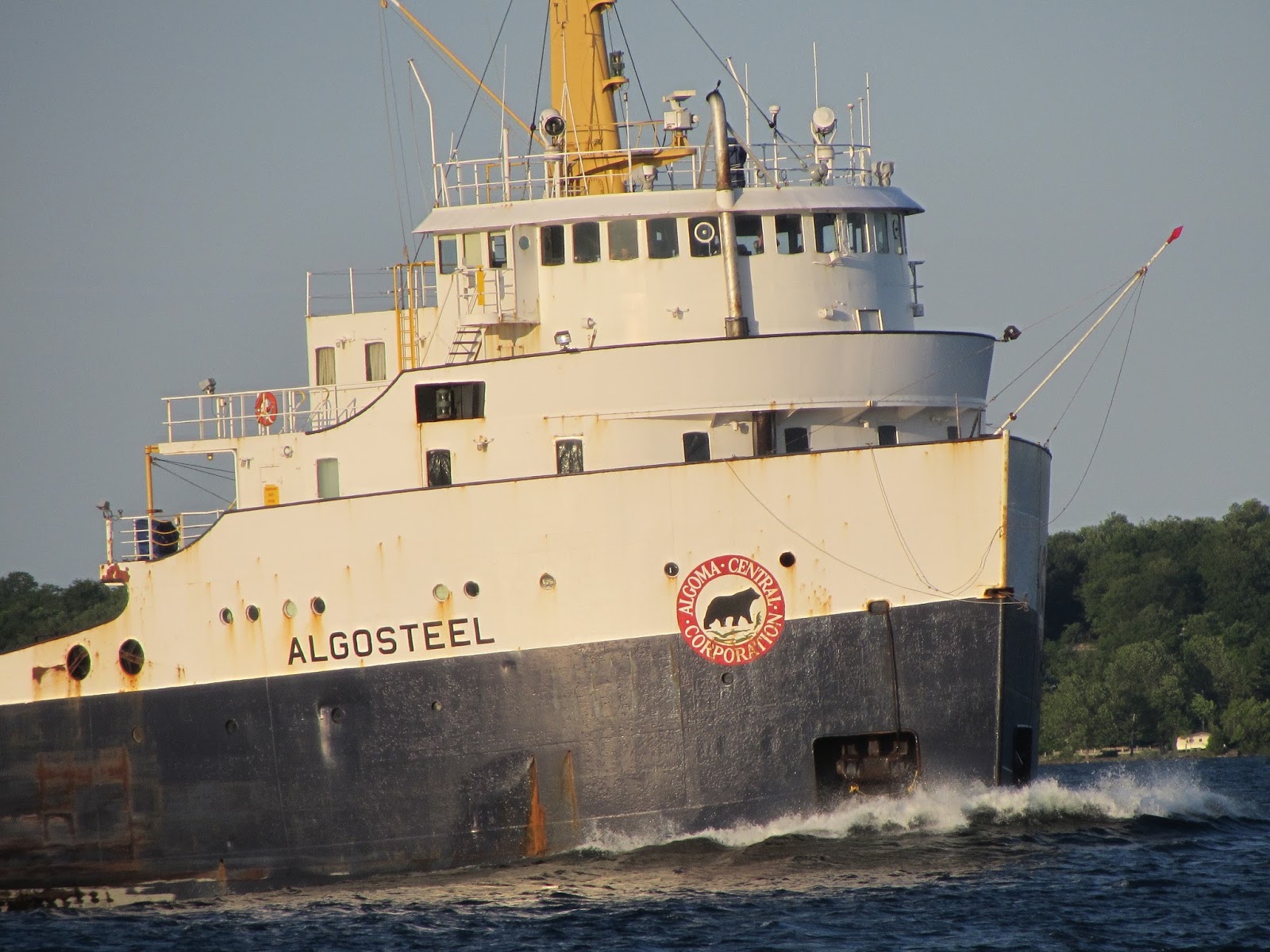
No bulbous bow on this ship of steel. Just a flat out maximum Seaway speed of 12 knots crashing into a steady head wind and the downstream current of the St. Lawrence River. All this resulting into making a lot of wave action and a constant stress on the aging bow plates of the 730' ALGOSTEEL which I snapped in  June in Brockville, Ontario. When the laker was launched at the Davie Shipyards in Lauzon, Quebec in 1966, she was a straight-deck bulk carrier for Labrador Steamships and her name was A.S. GLOSSBRENNER. Her main cargo back then was iron ore from the Gulf of St. Lawrence ports of Point Noire, Sept Isle and Port Cartier to U.S. steel mills and then would return to the Gulf with loads of grain destined for ports overseas.
In 1971, the GLOSSBRENNER was sold to Algoma Central of Sault Ste. Marie, Ontario and in 1987, she was renamed ALGOGULF. In 1990, the GULF was converted into a self unloader at Port Weller Dry Docks and was renamed ALGOSTEEL. As the STEEL motored by us at the river park, out came the converted schooner EMPIRE SANDY (Carlz Boats: 18.08.12) about to commence a 'three hour cruise' along the St. Lawrence during the 'War of 1812 Tallship Festival' in Brockville and just like at Canal Days in Port Colborne every August, a loud 'BOOM' could be heard from a ceremonial cannon on the SANDY to 'SALUTE' the impressive sail past of the ALGOSTEEL as she forged ahead to destinations unknown.

Monday, 2 September 2013

Saltie-Laker CANADA MARQUIS

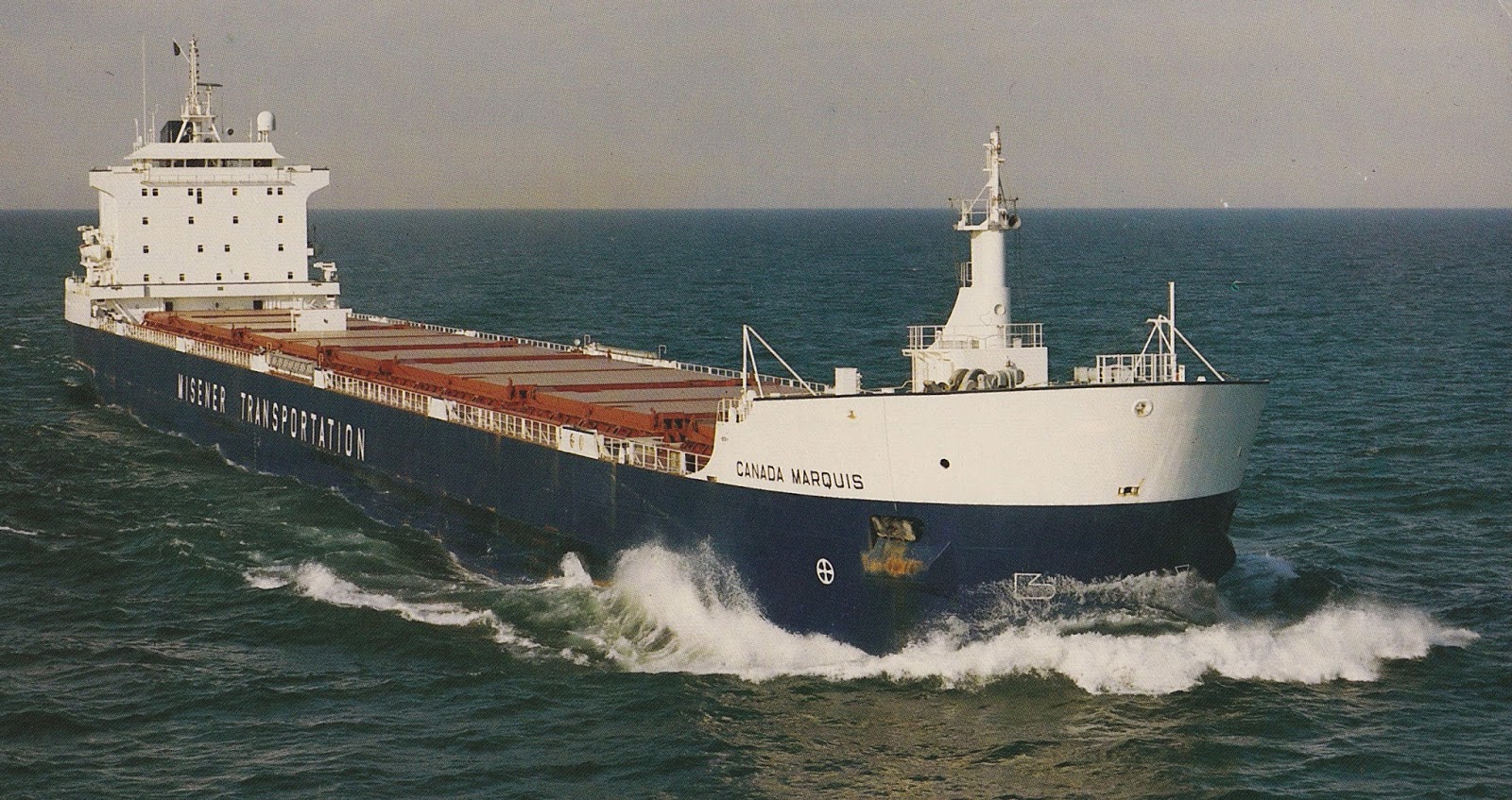
The CANADA MARQUIS. What a great name for a ship. 'Marquis', a nobleman, a person of stature. True, you may not be a Duke but at least you're not a lowly Earl. Heaven Forbid!! However, according my former Misener Transportation expert, Nathan Attard,   the correct pronunciation of "MARQUIS" is actually "MARKWIS" which a wheat harvested on Canada's prairies in Saskatchewan. Oops, I sit corrected c);-b.
Regardless, this MARQUIS was the second of three deep-sea or 'saltie' lakers for  Misener Transportation of St. Catharines, Ontario. While going through my files of snaps, I came across a postcard that Misener had printed of the then recent acquisition to their fleet, the 730' CANADA MARQUIS. Unfortunately, the card did not identify the photographer, but I'm certain a helicopter had to be used to get this dynamic shot as the proud CANADA MARQUIS pushed an onward sea over her bulbous bow with little resistance. She was built in Glasgow, Scotland in 1983 and sailed for Misener until 1991 when she was purchased by Federal Navigation of Montreal and her name was changed to FEDERAL RICHELIEU, then in 2001 FEDERAL MACKENZIE, both famous and important Canadian rivers. When Canada Steamship Lines purchased her in 2003, she began sailing with her current name, BIRCHGLEN, which is a nice tree and it's bark may have been used on the canoes the Iroquois used when padding down the Richelieu, or not.

However, earlier this spring, I snapped the BIRCHGLEN  (Carlz Boats: 31.17.12) as she inched her way through 'Iroquois' Lock. If you look closely, you may notice the embossed former name FEDERAL 'RICHELIEU' visible beneath BIRCHGLEN's white painted bow. Soon after leaving the lock, I snapped the stacks and superstructures of the BIRCHGLEN and her former fleetmate, FEDERAL KUSHIRO which was waiting below to transit the lock and continue upbound to Lake Ontario. With the lock and FEDERAL KUSHIRO to her stern, the BIRCHGLEN (below) picks up her pace on a calm channel while making her way to Quebec City and passing the original Iroquois Lock and entrance to the former Galop Canal. Time to 'Giddy-Up Go' until you can no longer.

Friday, 30 August 2013

Dry Cargo Ship VIKINGBANK


Just like the saying 'What goes around, comes around', so is true with ship designs. Back around the turn of the 20th Century, most warships including the Dreadnought-class battleships sported a reversed bow or as some called it then, a 'ram bow' which basically meant that when all other offensive measures have failed or aren't available, the order is simply, 'full speed ahead and prepare to ram' the enemy submarine or whatever in half. You do what you have to do to survive just like the ancient Athenians did in 535 BC, when the 'naval' ram bow was first recorded. Today, the inverted bow concept is making a comeback, not so much as a weapon but rather as a 'wave-piercing' bow design that allows the ship to slice through waves instead of rising over them in rough seas, and in doing so, it reduces fuel consumption and wave resisting drag.  
Earlier this month, I snapped the 468' Dutch dry cargo ship VIKINGBANK which is the first ship that I have ever seen with an inverted bow, which basically means that the longest point of the ship is below instead of above the waterline which one might generally see on current ocean going vessels like the IRMA (http://carlzboats.blogspot.ca/2013/07/bulk-carrier-irma.html). Built in 2012, the VIKINGBANK is owned by Pot Scheepvart of Delfzijl, NL and proudly motored by us at Loyalist Park near Morrisborg on her way to Trois Rivieres, Quebec like a true 'trend-setter'.