Sunday, 5 October 2014

Chemical/Product Tanker JO SPIRIT


Hello again!! We had a wonderful time during our 40th Wedding Anniversary tour to our old stomping grounds of Leamington and Windsor, Ontario with sidetrack boat snapping stops in Toronto, Port Burwell, Port Stanley, Kingsville,  Amhearstburg, Oakville, Clarkson and Iroquois Lock. WHEW!! That's a lot of motoring in just five days and once again, I've returned home with lots of great boat snaps but because of the day job, I remain searching for time to show off my snaps and tell you more about my "Excellent Boat Adventures" like when my boatnerd buddy Ron Beaupre of Mariatown invited me down to his place along the Seaway last weekend to a hear a special salute from the ship's captain of the ALGOMA EQUINOX who really liked my September 21 post about his ship. Click on to this link if you missed it: http://carlzboats.blogspot.ca/2014/09/gearless-bulker-algoma-equinox.html. To listen to my unique salute as the EQUINOX passed by Ron and Jeanine's beautiful waterfront home, click on this link: http://youtu.be/WqiiosuW_Ug. It's a BLAST, eh? What an honour and thank you Ron for making it happen.
Meanwhile, shortly after the downbound ALGOMA EQUINOX motored by, along came the upbound 352' chemical and product tanker JO SPIRIT with her load of booze. Say WHAT? c):-()

Yup, you read it right. According to Ron, at least once a year the JO SPIRIT ventures into the Great Lakes with her belly full of wine or other spirits, (pun intended, c);-b) and this time she was making her way to Hamilton, Ontario with 4,500 tons of Bicardi rum from the Caribbean. Oh YAAA!! c):-))
Built in 1998 and owned by Jo Tankers of Bergen, Norway, the JO SPIRIT has segregated stainless steel cargo tanks and since her hull is double-skinned, if the SPIRIT was to run aground, you couldn't have your "Rum on the Rocks"!! Sorry, about that. NOT c);-b
As the modern-day "rum-runner" JO SPIRIT approaches Iroquois Lock, in the background you can see the downbound 489' Polsteam bulk carrier NOGAT. The last time is saw the NOGAT, she was moored in Havana, Cuba. I got some really nice snaps of her leaving Iroquois so until I can post a re-visit, here's a link to my original Carlz Boat post about the NOGAT and our first visit to Cuba: http://carlzboats.blogspot.ca/2013/01/bulk-carrier-nogat.html Here's Mud In Your Eye!!

Sunday, 21 September 2014

Gearless Bulker ALGOMA EQUINOX


As soon as I found out my neighbour Glen and his family were heading up to Thunder Bay to visit relatives, I asked him to take a few snaps of the boats in the harbour. His initial response was kind of 'good luck with that' because he reluctantly said during other visits up there, he hardly recalled seeing any ships in the once busy Great Lakes port. He was still somewhat skeptical when I mentioned about the huge bumper crop of grain from the prairie provinces that was being shipped to Thunder Bay for loading into Great Lakes and ocean-going bulk carriers, destined to European markets.
ASTONISHING, for Glen and probably most anyone from or currently living in Thunder Bay, a community that was "hopping" in the grain storage and shipping business from the turn of the 20th century until the mid 1960's when transportation of goods to southern markets started switching over to trucks and rail cars as highways and railway lines were improved and expanded to the north and beyond.
But that all changed last fall when Canadian prairie farmers realized that despite receiving perfect weather conditions last spring and summer which produced bumper crops of wheat, canola and other grain products, they really had no place to store or get their grain to market. Prairie elevators and storage silos were over 100% filled to capacity which meant that whatever didn't make it into a building, got piled outside and covered under massive tarps for the winter. To make matters worse, the bumper crop caught haulers and rail carriers by surprise as most of their assets were allocated to transporting oil-sands crude to refineries in the States, out east or wherever. Since they couldn't say "Houston, we've got a problem!!", the called Ottawa instead where the Canadian government demanded CN & CP railways commit to shipping 500,000 tons of grain product per week or pay a weekly $100,000 fine. YIKES!! c)8-( Next problem to be solved: where is the nearest port that has the capacity to receive and transfer all of this grain to European markets ASAP? Answer: Thunder Bay with its 8 operating elevators, it's able to store over 1.2 million tonnes, the largest grain storage capacity in North American. YES!! c):-))
However, just when grain suppliers thought it was okay to start "rolling in dough", another obstacle appeared over the horizon: "Old Man Winter" and his dreaded "Polar Vortex" resulting in heavy ice conditions throughout the Great Lakes. Even Lake Superior was 70% frozen over and the ice at Thunder Bay was 4 feet thick. Despite a superb effort by American and Canadian coast guard assets, two Canadian Heavy Polar-class icebreakers and a high endurance icebreaker had to be diverted into the Great Lakes to help get the shipping season moving. Assisted with icebreakers, convoys of lakers started arriving at Thunder Bay a month later than normal and it is expected that the massive backlog of Western Canadian grain could take a full year to clear.
Meanwhile, back at the boat blog: Thank you Glen for your snap of what  looks a lot like  the 740' ALGOMA EQUINOX anchored off shore, and waiting their turn for a berth to take on a load of grain.


Last March I snapped the ALGOMA EQUINOX as she was laid up for winter off Cherry Street in Toronto. Just days after I found her sitting high in the water and appearing to be going nowhere fast, the EQUINOX raced across Lake Ontario and received the "Top Hat" honours at Lock 3 for being the first Welland Canal upbound for the 2014 shipping season on March 28. However, once she made it to Port Colborne, the EQUINOX could go no further due to heavy ice conditions on Lake Erie which was virtually frozen over during the winter due to the "Polar Vortex".

 Chopping at the bit for a load of "feed" in Thunder Bay, the EQUINOX had to wait almost a week before she and 4 other vessels left Port Colborne  escorted to the western end of Lake Erie by the Canadian Coast Guard heavy icebreaker DES GROSEILLIERS http://carlzboats.blogspot.ca/2014/04/polar-icebreaker-des-groselliers.html.  It wasn't until April 9th that the EQUINOX finally arrived at the Soo where she sat idle for another couple weeks while waiting for an icebreaker escort convoy to Thunder Bay. I'm not exactly sure when ALGOMA EQUINOX finally arrived at 'The Lakehead' though I'm sure she's made a few trips there and back since. c):-x

Built in Nantong City, China in 2013, ALGOMA EQUINOX is the first of eight of her class that are 45% more energy efficient than Algoma Central's earlier vessels. Like the first 4 of this class, the EQUINOX is known as a "gearless bulker", meaning that she needs shore facilities to load and unload. The remaining four in her class will be self unloaders. Designed to carry more cargo, consume less fuel and navigate with increased safety parameters, ALGOMA EQUINOX will primary transport grain to elevators in Baie Comeau (which is where she was going when I snapped her June 7th) and then pick up a load of Quebec or Labrador ore at a Gulf of St. Lawrence port destined to a Hamilton refinery. No matter how you slice it, it's a tough job and someone's got to do it to keep the economy going but at least each crew member has their own individual cabin complete with ensuite washroom, internet and satelite TV connections.
State-of-the art in more ways than one. I Likey!! c);-b

Monday, 1 September 2014

Packet Freight & Ferry NORGOMA

It's hard to believe it's almost a year since we did our "Whirlwind Tour to the Soo and Back". We got lots of great snaps along the way and including a few thousand footers from waterfront walk on the Canadian side of the Soo like my favourite the downbound AMERICAN CENTURY exiting the Poe Lock http://carlzboats.blogspot.ca/2013/10/self-unloader-american-century_6338.html.
In fact, while waiting for the CENTURY to motor out of the lock, I got a snap of Janie & Tanner near the former packet freight and passenger ferry, NORGOMA which is currently a museum ship at Roberta Bondar Park. The 150'x36' NORGOMA was built in 1949 at Collingwood Shipyards for the Owen Sound Transportation Company. Though the terrain along the North Channel of Lake Huron and Manitoulin Island is very picturesque, it's also quite rugged and back then there weren't a lot of good roads to service the many villages and fishing ports along that shoreline. Therefore shallow draft packet freighters like the NORGOMA were used to transport essential goods which sometimes included livestock. The five day and approximately 300 kilometre trip between Owen Sound and Sault Ste. Marie included stops in Killarney, Little Current, Gore Bay, Meldrum Bay, Cockburn Island, Thessalon, Hilton Beach, and Richard's Landing. Her cargo was known as "packet freight" because the goods (with the exception of the cattle) were packaged in crates or skids, and instead of being lowered into a hold, they were fork-lifted through wide doors along her hull that were located near her stern and midsection (cattle probably just walked on board, told them they we going to the zoo). The doors now appear to be welded shut but if you look closely you can see them in my snaps below? Once on board, the crates would be stacked much like that in a moving van and positioned for quick access during her many short port of call visits. The NORGOMA was "life-line" for so many isolated communities along the East-West route which was also known as the "Turkey Trail", perhaps because of her erratical course changes needed to service all of the ports or because the NORGOMA was also known to transport "turkeys" to Manitoulin Island. Therefore, even when the channel was calm,  the journey had to be pretty fowl when those turkeys were on board, and that's no bull!! c):))

Meanwhile, back at the blog, as new bridges were built for the railways and  TransCanada highway, the NORGOMA's outport services ended in 1963 as the transportation of goods and passengers could be done more effectively and less costly by trucks, trains and buses.
After being converted to a diesel motor ship and renovated to increase her capacity to carry cars, the NORGOMA started her new career in 1964 as a car and passenger ferry for Ontario Northland Railway. Transiting twice daily between Tobermory, at the tip of the Bruce Peninsula and South Baymouth on Manitoulin Island,  NORGOMA, along with her sister NORISLE remained in service until 1974 when they were replaced with the larger and more modern CHI-CHEEMAUN which could carry more passengers and cars than the sisters combined.

Since 1975, the proud NORGOMA has been toured by many Sault Ste. Marie visitors. Meanwhile, her sister NORISLE is also a museum ship at Manitowaning, on Manitoulin Island, and smaller fleetmate NORMAC, was the original Captain John's Floating Restauarant in Toronto Harbour, until it was accidentally rammed by the Toronto Island ferry TRILLIUM and sank at her berth (I remember that when we lived in TO). After being raised and refurbished, NORMAC apparently now services as a restaurant and cocktail lounge while parked in Port Dalhousie, Ontario. Oooo, we'll have to check her out during our upcoming whirlwind tour to Niagara, Southern Western Ontario, and the Detroit and St. Clair rivers. I can hardly wait. Really!! c);-b 

Monday, 25 August 2014

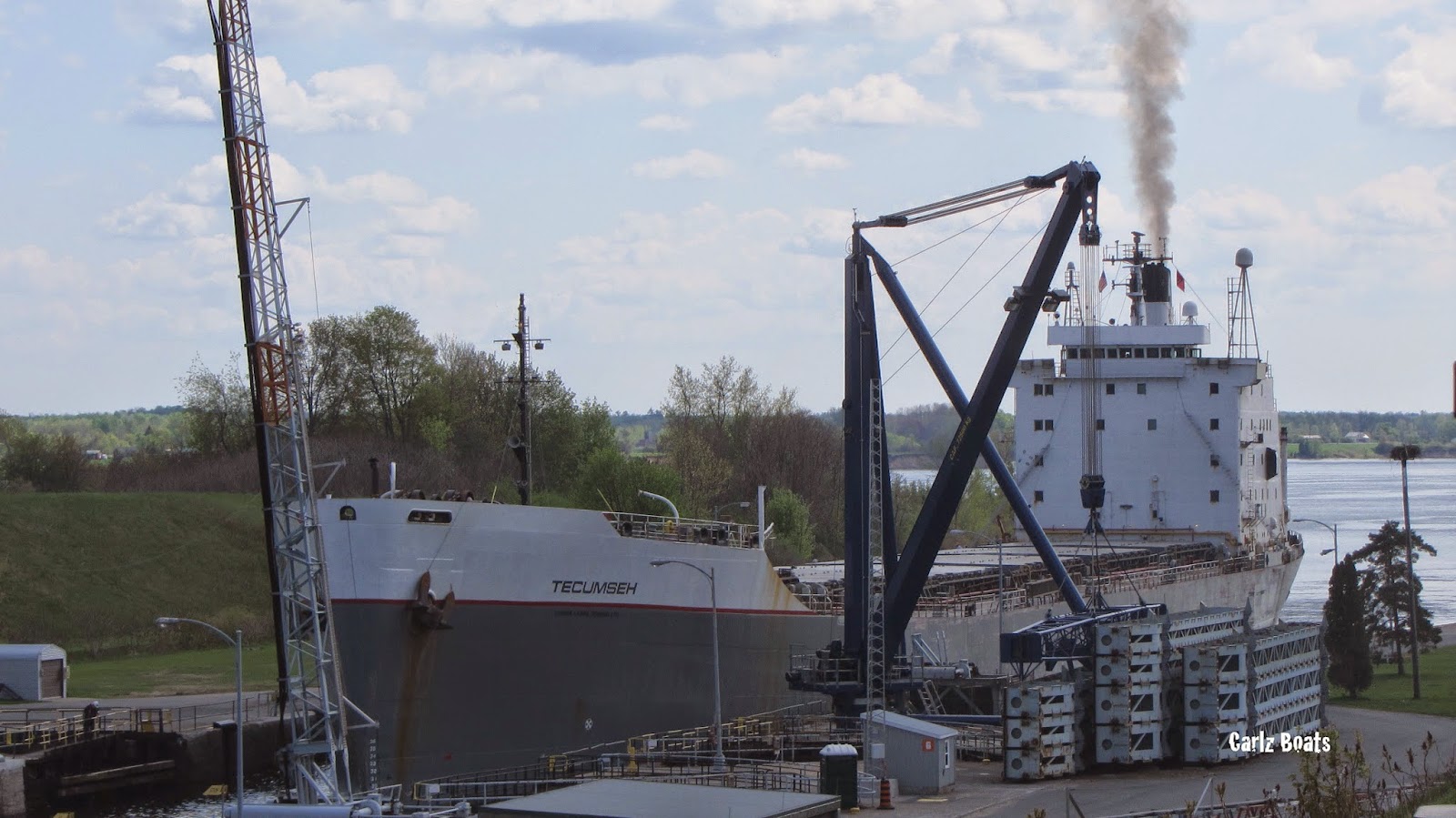
Bulk Carrier TECUMSEH

You've got to love the name selection for Lower Lakes Towing's fleet where all ships, with the exception of one, is named after First Nations leaders, their peoples or their unique translations. Like the classic straight-deck bulk carrier MANITOBA which like the Canadian province is named after what the Ojibwa people called 'Manidoobaa' meaning "Straits of Manitou, the Great Spirit" referring to the narrow channel at the centre of Lake Manitoba. The name of Lower Lakes bulk carrier KAMINISTIQUA (http://carlzboats.blogspot.ca/2012/07/salty-laker-kaministigua.html) is Ojibwa for 'river with islands', or their self unloader SAGINAW means "where the 'Sauk' peoples lived" in Eastern Michigan (http://carlzboats.blogspot.ca/2012/09/self-unloader-saginaw.html). Other Aboriginal named Lower Lakes ships include CUYAHOGA, MISSISSAUGI, MANISTEE, MANITOWOC and MICHIPICOTEN.
However, the ship name that I like the best is on their 641' bulk carrier TECUMSEH. Tecumseh was leader of the Shawnees and though he was born in Ohio, he became an ally of the British during the War of 1812. Tecumseh is honoured in Canada as a hero and military commander who played a major role in Canada's successful repulsion of an American invasion in the War of 1812. Chief Tecumseh was killed in the Battle of Thames near current Chatham, Ontario on October 5, 1813.

When the ship TECUMSEH was built at the Lockheed Shipbuilding yards in Seattle, Washington in 1973, her name was SUGAR ISLANDER and she was the largest American bulk carrier ever built to date. Her name was ideal because the SUGAR ISLANDER's primary task was to transport raw sugar from Hawaii to California. Later her name was changed to ISLANDER, JUDY LITRICO and then TINA LITRICO when she was purchased by Lower Lakes Towing Ltd. of Port Dover, Ontario in 2011. The gross tonnage for the TECUMSEH is 18,049 tons and she can carry a variety of dry bulk cargoes including grain, salt and iron ore. Her homeport is Nanticoke which in Delaware means "winding" creek, which incidentally is what makes Lower Lakes ships unique as they are smaller and able to maneuver shallower lake ports and winding rivers like the Cuyahoga, which in Iroquois means "crooked' river. There's a meaning for everything, eh!! c);-b      

Sunday, 17 August 2014

Heavy Lift Cargo Ship HHL CONGO (Revisited)

The first time I came across the upbound 453' HHL CONGO in July 2012, she was hauling a load of wind turbine towers across Lake St. Francis near Lancaster, Ontario. http://carlzboats.blogspot.ca/2012/07/cargo-ship-hhl-congo.html
On that day I didn't have my monopod to to help keep my little brownie steady when zooming in the far distant CONGO. Though it was getting dark fast, it was a easier snapping her last Thursday night as she approached and then transited Iroquois Lock on her way to Muskegon, Michigan. Instead of towers, this time it was turbine blades that were stacked high on her deck.      

When lauched in 2011 in Wuhu, Japan her name was BELUGA FEALTY. Later that year, she was purchased by Hansa Heavy Lift of Hamburg, Germany and  flies the flag of Antigua & Barbuda. Other HHLs that have frequented the Great Lakes includes the MISSISSIPPI, NILE, AMUR and the AMAZON which I snapped motoring downbound at near Mariatown on Labour Day 2012. Check it out: http://carlzboats.blogspot.ca/2012/11/cargo-ship-hhl-amazon.html 

Bulk Carrier FRITZ


Apparently the FRITZ is no longer "on the fritz", or is it? The FRITZ was built in China in 2012, and everything appeared normal for the 622' bulk carrier when she passed Gibraltar on May 29th with her 18 tonne cargo of steel rods destined for Toledo, Ohio. Again no problems were known when she entered the St. Lawrence Seaway's St. Lambert Lock on June 9th but on the next day, the FRITZ dropped anchor in the Seaway channel just west of Upper Canada Village near Morrisburg, Ontario (where I snapped these photos on Canada Day) and remained there for a month.
Initially it was reported that the reason for the FRITZ's unscheduled anchorage was due to engine problems. However as days passed it also became known that the crew's morale was also "on the fritz" as they had not been paid for over three month and the ship was running low on supplies of fresh food and drinking water. Meanwhile, residents on both sides of the border began complaining about the extended stay of the badly rusting eyesore in their front yards with its ongoing loud noises and bellowing smoke from the funnel. Finally the FRITZ got underway and arrived at Oshawa, on July 9 where financial woes continued for the ship owner, Intersee of Haren Ems, Germany, and for the striking crew who were heard pleading for equipment from with local fisherman so that they could catch Lake Ontario fish to survive. Eventually a new investor provided funds to allow the FRITZ to be moved to Hamilton to repair its still "on the fritz" engine while an Oshawa area Romanian church provided fresh food for the crew who were mostly from Russia and Romania though the ship flies the flag of Liberia.
With a repaired engine and somewhat happier crew, the FRITZ finally arrived in Toledo on August 9th, and thereby actually taking about two months to complete a journey that should have normally taken a only a few days once entering the St. Lawrence Seaway. Though her cargo was finally delivered, the FRITZ's future is still somewhat "on the fritz" as the "Made in China" rust bucket has been detained in Toledo indefinitely. "Pan-fried Lake Erie Perch, anyone??" YUMMY!! c);-b  


Wednesday, 6 August 2014

RO/RO Carriers CAPE KENNEDY & CAPE KNOX

"Roll On, or Roll Off, Rolling on the River". Sorry CCR for botching up your great classic rock song "Proud Mary", but when I saw these two huge grey ladies parked side-by-side along the wide Mississippi River in New Orleans last May, I first thought, "Ooo-Ooo, Navy Ships, my favourite" and knew we had to get ourselves on the paddle-wheeler NATCHEZ http://carlzboats.blogspot.ca/2014/05/steamboat-natchez_15.html (shown in this top snap) to check these girls out while we were "Rolling on the River".
But as we got closer, I could see that they weren't really navy oilers as anticipated, but instead two Roll On/Roll Off vehicle carriers, the CAPE KENNEDY (T-AKR-5083) and CAPE KNOX (T-AKR-5082) which both are operated by the US Navy's Sealift Command. Just like the snap shows as we approached them downriver, they are virtually twin sisters. They are both 696' long by 106' wide with a draft of 35' and have a top speed is 16.6 knots. They were also built at the same shipyard in Japan for Nedlloyd Lijnen of the Netherlands. The CAPE KENNEDY was launched as the NEDLLOYD ROSAIRIO in 1979 while CAPE KNOX was launched as the NEDLLOYD ROUEN a year earlier. In 1995 both vessels were purchased by the US Maritime Administration and placed on the National Defence Ready Reserve Fleet (RRF) and managed by Keystone Shipping in New Orleans. Currently there are 44 ships in the Ready Reserve Fleet docked in various ports along America's coastline, and 27 of the ships are RO/RO vehicle carriers.

Both CAPE KENNEDY and CAPE KNOX have side and stern ramps (the KNOX's stern ramp is lowered to the dock in my snap to the left) which enables wheeled cargoes to be driven on or off for loading and discharging much faster than conventional ships. Each also have 155,000 square feet of deck space on three cargo decks connected with ramps to move all sorts of military vehicles and aircraft. On their open deck, they can carry 1,550 containers or oversized military cargoes. Manned with a civilian crew, RRF ships take only 5 days to be activated and provide prompt sealift support in any event that they are needed which may also include peacekeeping or humanitarian response missions like during the aftermath of Haiti earthquakes.
Meanwhile, it's lay and wait time in the "Big Easy" for the sisters CAPE KENNEDY and CAPE KNOX until a need arises and so that they too will be "Rolling on the River" and showing their worth once again. c);-b