Wednesday, 5 May 2021

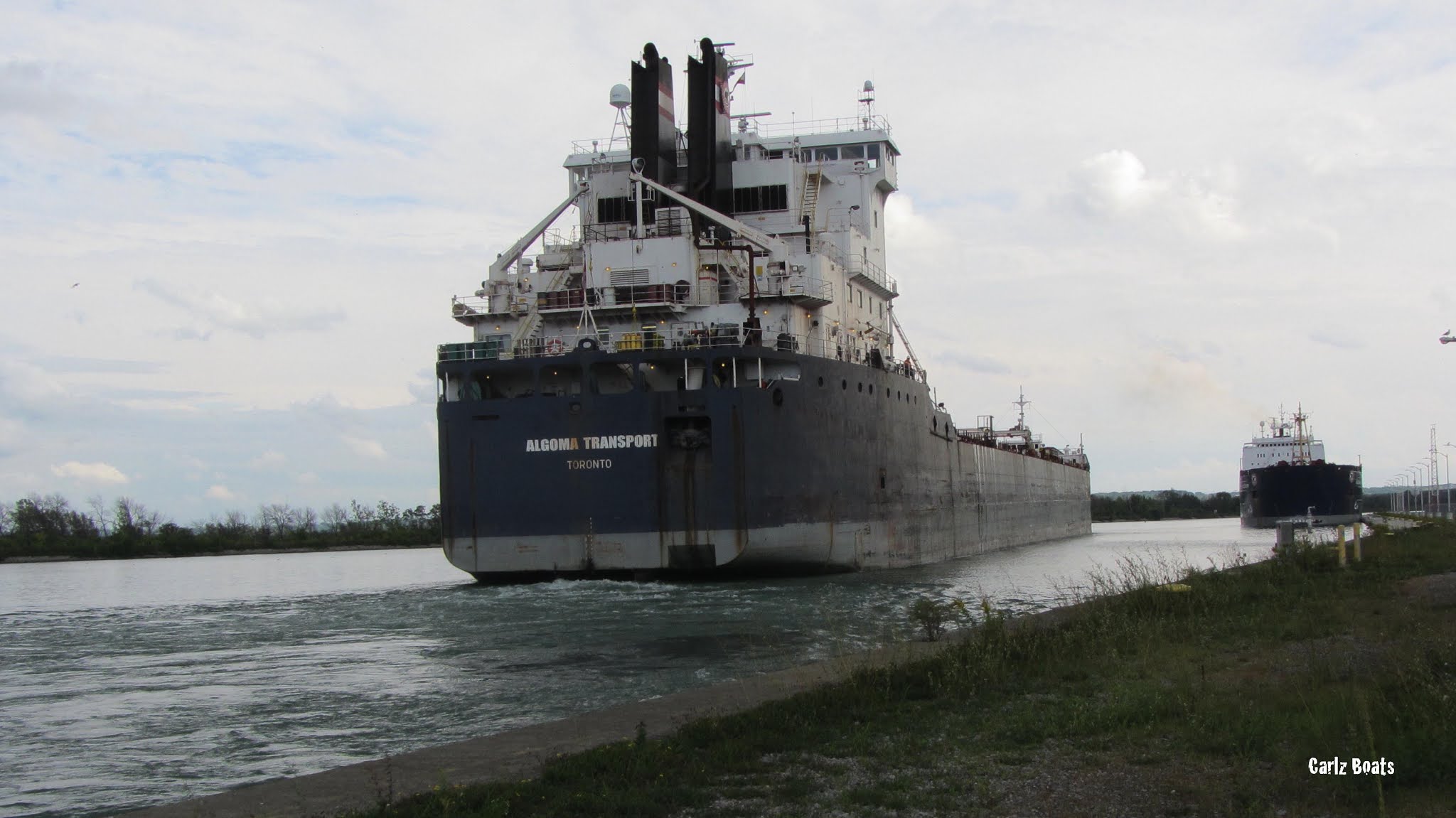
Above Lock 2: Upbound Self Unloader ALGOMA TRANSPORT

No question about it the observation deck at Lock 3 on the Welland Canal in St. Catharines is a unique place to photograph ships entering, being raised or lowered in the flight lock and then getting underway and out. However if you're looking for a place to park the car and get up-close and almost personal with a Great Lakes boat, above Lock 2 is one of the best vantage points on the canal, and that's where Janice and I caught the upbound 730' self unloader ALGOMA TRANSPORT on September 18, 2016. See for yourself:
 Yes, like everywhere else on the Welland Canal there's chain-linked fences there too but with the right camera 📷lens or cell 📲 phone you can get a pretty decent shot.


Bow plates on the then 37 years former Upper Lakes Shipping self unloader is showing their wear from rubbing on lock walls over and over again. At just under 76' wide, there's not a lot of room to spare in an 80' foot wide Welland and Seaway locks hence the rough look on even the newest of lakers.

My better-half, Janice got this neat shot with her iPhone. Pretty ugly clouds that day.
My turn to catch her line-rubbed bow and barbed-wire fence. Some things you simply can't crop out.
She was known as the CANADIAN TRANSPORT when built in 1979 just down the canal at Port Weller Dry Docks. Now owned by Heddle Marine of Hamilton, you can see all the action going on there these days from another neat viewing area above Lock 1.
Downbound fleetmate 729' gearless bulk carrier ALGOMA DISCOVERY approaches from Lock 3.
Riding high in ballast, the TRANSPORT's superstructure and twin stacks look ever taller from down below at wall level.

Powered with twin 10,000 horsepower diesel engines, the ALGOMA TRANSPORT picks up speed and veers left (or port) as the ALGOMA DISCOVERY makes her way across her bow over to Lock 2's approach wall.


ALGOMA TRANSPORT looked pretty good earlier from below Lock 2 too, eh!
 

Sunday, 4 April 2021

Light Icebreaker CCGS GRIFFON - A Homebound Pictorial

At a speed just under 12 knots, the 234' Great Lakes ice breaking icon for over 50 years, CCGS GRIFFON pushes a steady white wake as she continues to make her way home to the Canadian Coast Guard station at Prescott on Tuesday morning.


While ship traffic comes to a stop in these parts with the closing of the St. Lawrence Seaway on December 31st, it's business as usual on most of the upper lakes.  

Throughout the winter months tankers continue to haul liquid asphalt and other oil and chemical products from Sarnia on the St. Clair River to Nanticoke more than half way down Lake Erie with deliveries to ports in between.
Meanwhile self discharging bulk carriers continue to replenish road salt supplies from Goderich and Windsor to U.S. ports like Milwaukee, Chicago and Detroit.
While all bulk carriers and tankers have strengthened hulls to operate through ice, sometimes they need help and that's when the Canadian and U.S. coast guards work together as one to keep the shipping lanes clear so that the commerce can keep moving. They are also busy keeping river months clear from jamming with ice and potential flooding upriver. Both tasks were no different this year especially in February
With her speed checked down, the GRIFFON starts her "U-turn-like" maneuvre so that when she approaches the dock, she'll be facing upriver.


In the background you can only see about two-thirds of the 2.4 km long Ogdensburg-Prescott International Bridge and one of my favourite vantage points, the old Windmill Lighthouse as the GRIFFON continues her turn in this wide section of the St. Lawrence River. 

Though built in 1970 at Davie Shipbuilding in Lauzon Quebec, CCGS GRIFFON is well maintained and has been refitted and modernized throughout her 51 year career. Nice paint job too.
As a Type 1100 buoy tender, the GRIFFON is known as a High Endurance Multi-task Vessel. Though she has a flight deck, the GRIFFON does carry a helicopter like newer vessels in her class.
Her Arctic Class 2 ice classification allows her to maintain a speed of 3 knots through 2 feet of ice. She encountered ice at least that thick and several feet of high wind-blown ice ridges when the GRIFFON and fleetmate, CCGS SAMUEL RISLEY  freed the American ore carrier ARTHUR M. ANDERSON which had been trapped in the ice on Lake Erie for 5 days off Conneaut, Ohio in February 2015.


The tall GRIFFON snuggles-up behind the Parks Canada research vessel DAVID THOMPSON, and then she's secured at her home until her next assignment.
It was dull and overcast without as much wind when I last caught the GRIFFON's return home on April 4, 2018. Then I caught her arrival on the east side of the coast guard station and as my camera continued to click away I suddenly noticed someone standing ahead to right on the rocks (in the photo below). It was Joanne Crack, founder of the Facebook boat-watching group The Prescott Anchor there taking her photos of the ship and crew that she loved so much and always talked about. It's so sad that we lost Joanne in September 23, 2019. 
Joanne took some wonderful photographs of ships passing by from her balcony along the river. She was such a great help for my blog over the years and I miss her a lot.


While there maybe a well deserved break for the crew that manned her for the last month or so, there will be no rest for the mighty GRIFFON which has already made her way down river to replace winter navigation markers with 6' tall 6,000 lb. solar powered light buoys which will stay in place attached to a 5,000 lb. anchor until it's replaced next fall. It's all part of the circle of life for our hardworking "multi-tasker" also known as CCGS GRIFFON.


Saturday, 20 March 2021

Classic Self Unloader MICHIPICOTEN

The unique Lower Lakes Towing and Grand River Navigation logo and acknowledgement of Indigenous Peoples throughout North America on the MICHIPICOTEN's stack was last piece to be placed in my latest Jigsaw Planet puzzle of leaving Iroquois Lock on July 18, 2020. Like so many others in the combined Rand Logistics fleet that are named after First Nation's leaders, rivers and lakes, MICHIPICOTEN is an Anglicization of the original Ojibwe word "Mishipikwadina" meaning "Big Bluff" which refers to the high hills near the mouth of Michipicoten River where the First Nation band has lived since before the the first arrival of European settlers at the north-east region along the shoreline of Lake Superior. Located16 kilometres at its closest point to the Ontario mainland, Michipicoten is also the name of the Lake's second largest island which is known for its rugged steep slopes and is plentiful of wildlife like beaver, woodland caribou and birds.


Her name was ELTON HOYT 2nd named for the then President of mining company Pickands Mather when launched in 1952 for Interlake Steamship Company and she was one of three lakers that were built along the Atlantic seaboard at the Bethlehem-Sparrows Point Shipyard at Sparrows Point, MD, because shipyards on the Great Lakes were backed up in orders. The other two lakers owned by Bethlehem Steel were the JOHNSTOWN, named for the community where one of their steel mills was located in Pennsylvania, and SPARROWS POINT, for the location of their shipbuilding operation.


Since the vessels were to be brought to the Great Lakes via the Mississippi and Illinois Rivers, their size was limited. The ELTON HOYT 2nd measured 626 feet 6 inches long, 70 feet wide, and 37 feet deep, which gave her a capacity of approximately 20,000 tons. However to clear the lower bridges along the waterways north, her cabins and pilothouse were cut apart and carried on deck for the tow through the rivers. After being assembled in Chicago, the HOYT entered service on August 15, 1952, and like other Interlake vessels, she began hauling iron ore mainly from the docks in Duluth or Superior to steel mills in various of lower Lakes ports. The ELTON HOYT 2nd also visited the new loading dock at Talconite Harbor, taking on talconite pellets that were mined at the Hoyt Lake which was founded by her namesake in 1955.

Though lengthened by an additional 72' in 1957 to her current size of 689.5', the time spent unloading the straight-decker made the vessel less competitive. While the HOYT was slightly smaller than other vessels her age, she would still spend upwards of 12 hours unloading. So in 1980 the vessel was converted to a self-unloader at American Ship Building Company in Toledo, which added many years to her career.

However after a 3 year layup in Superior, WI due to a reduced demand in steel, the sailing days for this hardworking ore carriers that bore the same name and flew the Interlakes Steamships flag for 51 years ended when she was sold to the Canadian shipping company, Lower Lakes Towing of Port Dover, ON, on April 10, 2003. The renamed MICIPICOTEN entered service for here new owners primarily supplying taconite pellets to the Algoma Steel mill at Sault Ste. Marie, Ontario in May 24, 2003.

While her size and stern mounted self unloading boom has offered the MICHIPICOTEN the ability to discharge a variety of cargoes to ports seaway-max vessels couldn't visit, it was iron ore that the 68 year old veteran laker was hauling to Quebec City when I caught her slowly entering Iroquois Lock and positioned perfectly all the way in due to the cautious eye of her deckhands spotting her distance away from the rugged concrete lock walls.

Like the CSL TADOUSSAC had just completed and was returning up towards to the Lakes when I caught her a month earlier on June 15th at the Seaway lock, Minnesota mined iron ore that had been discharged by thousand footers like the EDGAR B. SPEERS at Conneaut, OH, was then loaded onto Canadian bulk carriers like the MICHIPICOTAN, because there are simply not enough American-flagged seaway-max self unloaders to do the job. 


Iroquois Lock is a great place to view boats and a family of osprey perched atop a former light standard seen to right of the MICHIPICOTEN's wheelhouse.


Seaway workers were on hand to secure or walk the MICHIPICOTEN through the lock that's normally lowered about foot for downbound vessels.

Though currently flagged Canadian, the U.S. flag flies from her forward mast as a courtesy of the several times the bulk carrier will enter American waters during her St. Lawrence Seaway transit.

Visible through the legs of one of the two control dam gantry cranes capable of lifting 350 tons, the 453' HAPPY ROVER waits on Lake St. Lawrence for her turn in lock.

Ore dust laying everywhere and clinging to her side gives the normally immaculate vessel an unfair rustic look.


Further down she moves but not wanting to touch the steel fluorescent-marked arrester which protects the lock's gates and bascule bridge...

As the west-end arrester is lowered...

...the opening of the gates and the raising of the bridge and arrester at the other end of the lock signals to the skipper it's time to get a move on.

At the end of her 2010 shipping season, MICHIPICOTEN's original steam turbine and boilers were removed during her winter layup in Sarnia and replaced with a new MaK 6M32C 6 cylinder 8,160 BHP diesel engine. Combined with a newly installed controllable pitch propeller, the new powerplant was capable of pushing her up to 14 knots when she returned to service in May 2011 while being more fuel efficient and reducing emission levels.


And with her big engines churning away, the classic MICHIPICOTEN makes her out of the lock allowing the bound for Monroe, MI, Big Lift general cargo vessel HAPPY ROVER to take her place and become the subject for my next Jigsaw Planet puzzle...click the link below to put it together. It can be a lot of fun, No bluffing, really c):-D

https://www.jigsawplanet.com/?rc=play&pid=1f87603fab71