Thursday, 21 May 2020

Polsteam Bulk Carrier WICKO

Pretty nice meet of the downbound WICKO & upbound ARAGONBORG if only something wasn't in the way. 😁
Unless you've been sitting on Uranus, or Mars, for the last couple of months, you will have noticed that we are living in much different times. No continent with the exception of Antartica appears to have been spared of this highly contagious bug and as a result, virtually nothing that we may have done prior like a simple or normal daily routine can be taken for granted anymore and for some time after this horrible deadly pandemic nightmare is over.  I'm not going to get into how this dilemma has impacted others and me, especially with my part-time job working as a funeral director assistance because it's just too depressing and after all, this is a "Boat-Blog" and anyone who's been chasing ships since at least 9/11, has been having to deal with all kinds of obstacles like high chain-link fences to heavy cement barricades to get that prize pic in. It is what it is.

The fencing that got in the way of most of my pics here when I finally caught up to the 623'4" Polsteam owned bulk carrier WICKO last Thursday had nothing to do with the COVID-19 restrictions but rather belongs to the Ingredion Canada corn starch plant that spans the complete southern point that kind of juts into the St. Lawrence River in the village of Cardinal, Ontario. With my zoom on the fritz and no place to take it in for repairs due to all the pandemic store closures, I've had to become very selective in finding a vantage point which would give me a decent photo with my standard lens. East of the village between the water filtration plant and the former Canada Starch Works is a great spot and that's where I wanted to catch the upbound Dutch flagged ARAGONBORG underway above Iroquois Lock but had to settle with her meeting the WICKO behind all the fencing above. Will have check her out in my next post at Windmill Point.
Would've loved to have snapped the WICKO where that security guard is but no can do in this day and age, eh!  
While most Polsteam bulk carriers are named after Polish rivers, this one is named after Lake Wicko in northwestern Poland. Actually, earlier in time, it was a fairly large bay that  due to constant wave action a wide sandy spit which is now forested over was created preventing the flow back into  to the Baltic Sea. The 5 km long lake is quite shallow and ideal for fishing 🎣. The downbound for Montreal WICKO was built in 2010 at Mingde Heavy Industry in Nantong China and flies the flag of the Bahamas πŸ‡§πŸ‡Έ. Now off to Windmill Point to catch the Royal Wagenborg's tweener. Explanation to come in my next blogpost.

Tuesday, 24 March 2020

CCGS PIERRE RADISSON - Medium Icebreaker (Revisited)

Built in 1978 CCGS PIERRE RADISSON is makings good speed by Crysler Farm Battlefied Park and Mariatown.
What a difference a year makes. About this time last year I was standing along the St. Lawrence River listening in aw as the big or as the Canadian Coast Guard prefers to call it, medium icebreaker PIERRE RADISSON crashed through a huge field of ice east of Morrisburg like a knife slicing through whipped cream. It was March 22, and the RADISSON was on her way to assist shipping on the upper Great Lakes an activity that she'd been required to do in past, with the exception of perhaps this spring.
Unlike this winter where except for my backyard, much of the Great Lakes region had very little or no snow at all, and most bodies of water were completely free of ice while in mid January 2019, Lake Superior had lots of it and Erie was over 90% ice covered in places. To makes matter worse, gale force winds blew across the continent in February causing huge ice ridges and banks that I hadn't seen since I was a kid growing up in Port Colborne. Along with the help of their American counterparts the Canadian Coast Guard's "Light" icebreakers GRIFFON and SAMUEL RISLEY which had been busy all winter escorting tankers and other carriers to supply communities with needed cargoes, could not break through either. The cry went out and the mighty PIERRE RADISSON was on its way in.
Today the Welland Canal opened and from what I've seen in Janey Anderson's Facebook ship watcher's posts, who was at Port Coborne this morning, no vessels encountered any ice issues. Such was not the case when the RADISSON arrived at Port Colborne a year ago today. Not only was there ice in the harbour, but not far from the canal entrance breakwalls, she encountered ice ridges two and half to three metres high. It was almost a week before the PIERRE RADISSON and GRIFFON could make safe shipping tracks for the 10 vessels waiting in Port Colborne and at various walls along the canal, to get their season underway.
Photo by Our Midland.ca Local News - April 19, 2019
Meanwhile, the call went out for the light icebreaker MARTHA L. BLACK to assist at Cape Vincent at the St. Lawrence Seaway's Lake Ontario entrance because of ice ridges there, and two more medium icebreakers. Once CCGS AMUNDSEN arrived then followed by CCGS DES GROSEILLIERS soon after, the PIERRE RADISSON continued up through to Thunder BAY and eventually broke out BAIE COMEAU in Midland on April 19th which had been trapped there due to ice ridges on Georgian Bay as well.
 
Arctic research vessel during the summer CCGS AMUNDSEN breaks ice in winter at Mariatown - April 4, 2019.
CCGS AMUNDSEN (formerly SIR JOHN FRANKLIN) was the second medium icebreaker built in 1978 at Burrard Dry Dock, North Vancouver.

Light icebreaker CCGS MARTHA L. BLACK also no stranger to spring ice operations on the Great Lakes disturbs a flock of Canada Geese while approaching Iroquois Lock on March 27, 2019. 
Dark sky and setting sun as DES GROSEILLIERS passes Morrisburg.
- April 10, 2019.
The 5,775 gross tonne 322'  medium icebreakers are designed for Coast Guard operations in the Arctic Ocean. Their two fixed-pitch propellers are powered by 6 Alco M241F diesel engines that when driving the shafts can create 17,580 shaft horsepower which allows their powerful propulsion system to break ice over a metre thick at a speed of 6 knots. They have a top speed of 16 knots (30 k/h, a range of 15,000 nautical miles and cants at sea for up to 120 days. They have a flight deck with a retractable hanger to house their light Bell 206L helicopter which provides air reconnaissance to identify safer commercial routes.

CCGS DES GROSEILLIERS was built in 1985 at Port Weller Dry Docks in St. Catharines.
CCGS GRIFFON returning home to Prescott from winter ice ops - April 4, 2018
Between late December 2018 and April 2019, six Canadian Coast Guard icebreakers travelled 19,173 kilometres escorting commercial vessels through the ice on the Great Lakes. Canada and the United States shares icebreaking duties between our two nations as needed and combined with U.S. Coast Guard vessels, they assisted 522 ship transits. While light icebreakers CCGS GRIFFON and SAMUEL RISLEY are dedicated to the Great Lakes each year, it sure is nice to know that once old man winter with his arctic blast from over the top returns, at least there's a few extra big or "medium-sized" guns available to make a clear passage regardless of the flag your flying.
CCGS SAMUEL RISLEY lowers a workboat at Johnstown - September 5,2015

Saturday, 29 February 2020

Last River Run - Part 2: Bulk Carrier FEDERAL ALSTER


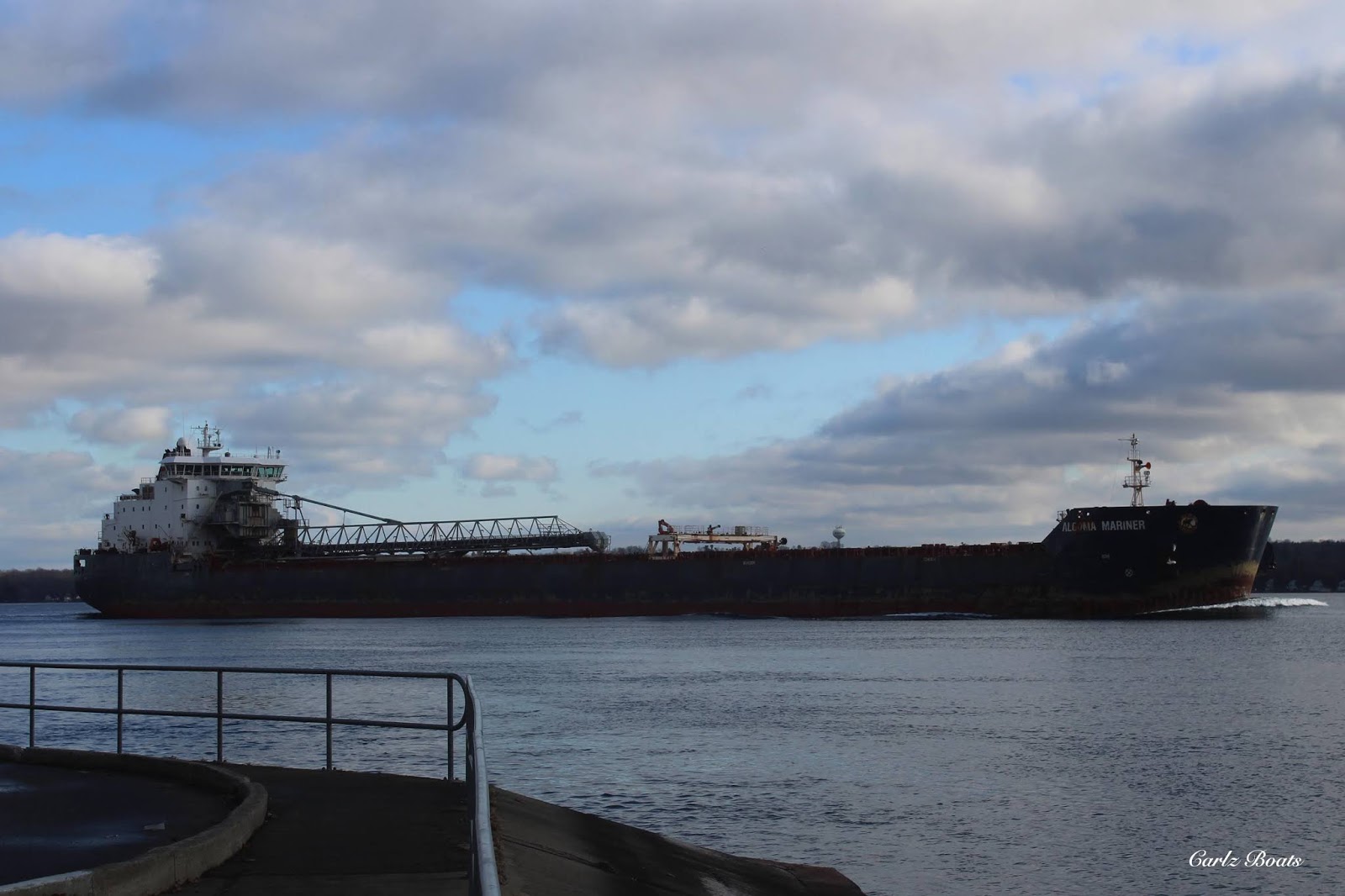
Having caught the 740' Algoma Central self unloader ALGOMA MARINER motoring by upbound at Brockville, the subject for my last post, I couldn't believe my eyes when I saw the Fednav bulk carrier FEDERAL ALSTER on her final run for the season still making her way into Iroquois Lock on December 28th. Though somewhat distance, the ALSTER was an easy target when I saw her for the first time from the Battle of the Windmill National Historic site on September 30th while sitting high and hatch covers raised across the St. Lawrence at the Port of Ogdensburg. On that day it appeared that she was finishing her discharge of Chilean road salt, the overseas product I've seen seen being unloaded by many of her fleetmates this season at the Port of Johnstown, on the Canadian side of the river.
With the booms of her four 36 metric ton carrying cranes secured to each other, the  FEDERAL ALSTER appeared to be moments from getting under way when I caught her again from a new vantage point at a dead-end in the old hamlet of Wexford three days later.    


My zoomed-in shots across the St. Lawrence were pretty easy pics taken in my "as-per-usual" dull overcast skies unlike my last rendezvous with the FEDERAL ALSTER when the sun continually broke through the clouds (not complaining, I like the sun 🌞), causing sunspots or a ghost-like haze on so many of my photos. No excuse these days with digital cameras. I should have seen what was happening and adjusted things up, but I didn't notice a thing until I got home in Ottawa so what you see is the best of what I could salvage on what should have been a great photo op.
Built in 2016 at New Century Shipbuilding in Jingjiang City, China, the FEDERAL ALSTER is known as a laker-design dry goods bulk carrier because much of her trading activity is between overseas ports and those on the Great Lakes. At 655' 11' in length, she's a bit shorter than St. Lawrence Seaway maximum-size vessels like the 740' ALGOMA MARINER (https://carlzboats.blogspot.com/2019/12/last-river-run-part-1-self-unloader.html) which I'd seen earlier in the day, but with all seaway lock being 80' wide, the FEDERAL ALSTER's 77' 9" beam makes her a tight squeeze at Iroquois and the other 14 locks in the system between St. Lambert, across from Montreal and Lock 8 in Port Colborne, on Lake Erie.
FEDERAL ALSTER which is named after the Alster River, a tributary to the Elbe River in northern Germany, flies the flag of the Marshall Island though owned by Intership Navigation Company of Limassol, Cyrus and while being chartered to Fednav of Montreal. In her 6 hold that were strengthen for heavy loads, the ALSTER has a cargo capacity of 22,947 gross tons.

What seemed odd though as the immaculate red hulled vessel pushed her way out of the lock and into Lake St. Lawrence, was that her free fall lifeboat was not in its davit at the ALSTER's stern. If you squint real hard at the photos I got of her in Ogdensburg, above, the fully encased bright orange lifeboat is where it should be.
Equipment with a motor, radio, navigational aids, fishing equipment and other supplies needed until rescue arrives, it's been required since 2006 that all ocean bulk carriers be equipped with a free falling lifeboat because they are at risk of sinking too rapidly for a conventional lifeboat to be lowered over the side of the sinking or listing ship. While I've not read of any such incident occurring on a Fednav vessel during it's 75 years of operations, I'm sure that matter would have been resolved before reaching the open water of the Atlantic Ocean.

As the big FEDERAL ALSTER pushed on towards Eisenhower Lock, in the distance was another red-hauled vessel with a tall white superstructure that especially stood out in a bright sunbeam off the bulk carrier's port bow. I knew CCGS GRIFFON was in the area but instead of making her way to her homeport at Prescott before heading to the upper Great Lakes for winter ice operations, the 234' high endurance multi-tasks vessel had her boom over to her starboard side and was working. πŸ†’, let's see what she was up to in Part 3 of my Last River Run of the season next month at Carlz Boats blogpost. I can hardly wait to show you c):-D

Tuesday, 31 December 2019

Last River Run - Part 1: Self Unloader ALGOMA MARINER


It’s that time of year again. It just seems like yesterday that I was standing at Loyalist Park about midway between Morrisburg and Iroquois on Lakeshore Drive waiting for the first upbound of the new shipping season, the 656’ Fednav bulk carrier FEDERAL KUMANO to motor by. While the weather conditions were almost identical with a scattering of snow on the ground and temps hovering above freezing, it was actually 9 months plus 2 days from my first to Saturday’s last run to  the St. Lawrence River.
FEDERAL ALSTER unloading at Ogdensburg, N.Y. - September 30. 2019
I’ll admit it, the ship that I wanted to get was the FEDERAL ALSTER, also a Fednav laker-type bulk carrier which I caught unloading across the river at Ogdensburg in June and was going to be the second to last saltie to make it out of the Great Lakes before the St. Lawrence section of the Seaway closed today at noon.
True, I would have liked to get the very last downbound saltie of the season but the FEARLESS was still somewhere out on Lake Erie, it was virtually empty due to a freezing problem in her lines that was discovered in Thunder Bay. There were even concerns that she maybe wintering there. She was to be passing through Iroquois Lock later Sunday afternoon which was when a major ice and winter storm was to blow through our neck of the woods, making it pretty risky for my drive from Ottawa to the River and back. As it turned out though the FEARLESS motored from the Lakehead high in ballast on schedule and the winter storm was a day late. What are you going to do 😁.
However as an added bonus, I saw that the 740' Algoma Central self unloader ALGOMA MARINER was also making her last upbound river run so it was off to Brockville to catch her first.


ALGOPORT unknowingly leaving Great Lakes for last time
- taken by Ron Beaupre - June 28, 2009
Now here’s a ship with a very interesting background which could explain for her rugged well worked look. She all came to be due to an unfortunate happening to the then often idle Algoma self unloader ALGOPORT which sank in the East China Sea off Japan on September 6, 2009 while being towed to China for a new forebody. The plan for the 680’ Nova Scotia-class ALGOPORT which was named for my old hometown, Port Colborne, was to have a new longer and wider Seaway-max forebody, (a.k.a. the cargo holds and bow section of a ship) attached to her wheelhouse and accommodation stern section. The plan worked for ALGOPORT’s sister, ALGOBAY which now plies the Great Lakes and eastern seaboard during some winter months as the RADCLIFFE R. LATIMER.
ALGOMA MARINER about unload more road salt at the Port of Johnstown - June 18, 2018. 

Wheelhouse similar to next generation Equinox-class newbuilds.
With no stern section to attach to it, the new forebody sat idle for a year until Upper Lakes Shipping Corporation decided to use it for a new self unloader to be named CANADIAN MARINER. However that name was changed to ALGOMA MARINER when Algoma Central acquired Upper Lakes Shipping's complete fleet in February 2011. With the exception of a bulbous bow which is common for ocean-going freighters, the wheelhouse and accommodations section of the new ALGOMA MARINER looks very similar to the company’s current Equinox-class gearless and self discharging bulk carriers, don't you think.


When the new vessel arrived at Port Cartier on August 2, 2011 to pick up a load iron ore pellets for a Hamilton steel mill, her port of registry was Toronto, where previous-owner's  head office was located but soon after it was changed to Port Colborne and then dedicated at a special ceremony at the Lake Erie port on August 25, 2011 in recognition of the communities long standing relationship with Algoma Central and for company’s subsidiary Fraser Ship Repairs, which has been based in Port Colborne for many years. Kudos to Algoma Central for that and the ship-like designed skateboard park at Lock 8 which is named ALGOPORT.

Downbound ALGOMA MARINER plays peekaboo between the
shoreline trees and islets east of Cornwall - June 15, 2015
After an unexpected Captain's Salute of one long and two short blasts from her horn πŸ“’ to the group of us present for her last upbound run past Blockhouse Island Park, I was able to continue to track the Coastal-class ALGOMA MARINER despite a few glitches with my Canon πŸ“·Rebel (appropriately named) as she made her way towards the Brockville Narrow until she was nearly out of sight. For the last few days she's sat anchored of Port Weller and east of the Burlington Skyway. However according to MarineTraffic she is currently underway bound for Clarkson to finally deliver her cargo. After that she probably layup for winter in Hamilton or with the Welland Canal still open until January 8th, perhaps another run to the upper lakes is in order for the 8 year old ship. we'll keep you posted.

Meanwhile, coming up in Part 2 of my "Last River Run" we'll be at Iroquois Lock to meet up with the FEDERAL ALSTER during her escape from the Great White ⛄ North and in the distance, another "Red Boat". Canadian Coast Guard ship GRIFFON. I wonder what she's up to? Well you'll find out NEXT YEAR!!! Until then have a Happy New Year πŸŽ‰, thanks for reading my blog and saying so many nice things about my pics. Take care and I wish you All the Best in 2020. πŸ‘‹. 

Monday, 2 December 2019

Chemical/Oil Tanker CHEMBULK YOKOHAMA


Carl and a boat c);-b
While waiting for the ghost ship on the horizon to approach McNair Island and beyond on Remembrance Day, Janice, my better half, who was sitting in our nice warm KIA Sportage said, "Gee, I sure wouldn't want to be on those ships during weather like this". Very true, but what about your boatnerd husband whose been standing on a snow covered hill for who knows how long waiting for the upbound in near blizzard conditions in a quasi fall jacket and a hoodie. BooHooHoo 😒 to you, Yeah I hear ya.
Like we'd done a pretty good job of staying ahead of another early cold winter blast that had made it way from over the top and was continuing to spread a wide swath of the white stuff from west of London through to the Quebec border. Yes, that in itself was a clear warning to stay in the car πŸš™ and go home, but the 476' tanker CHEMBULK YOKOHAMA was just a few minutes or 10 away so how bad could it be? According to the Weather Network app it was a balmy -5 celsius or feeling like -11C in the 30 kilometre wind gust, but I'll tell you it was a lot colder than that πŸ’¨πŸ˜.

Actually, Janice was right on the mark. November can be brutally cold with snow, high winds, and sadly too, deadly for mariners on the Great Lakes. A "November Gale" or also known as a "November Witch" are storms that can maintain hurricane-force wind gusts, producing waves 50 feet high, and dumping several inches of rain or feet of snow and last for several days over the Great Lakes region. Since 1847 there's been at least 25 killer storms striking the Great Lakes like during the Great Storm of 1913, 13 ships sank and another 19 were damaged or run aground killing 244 sailors, including 6 crew members of Buffalo Lightship LV-82 that was anchored off Point Abino east of Port Colborne and found 2 miles from its assigned location in 63 feet of water. During the Armistice Day Blow of 1940 which lasted from November 11-12, 5 ships sank and 66 souls were lost. The 639''American self unloader CARL D. BRADLEY sank in a Lake Michigan storm on November 18, 1958 taking 33 of her 35 man crew, while only one sailor survived when the 603' bulk carrier DANIEL J. MORRELL broke up during a strong storm on Lake Huron on November 29, 1966 taking 29 sailors down with her.
In the United States, a gale warning is issued by the National Weather Service (NWS) when wind strengths range from 34 knots (63 km/h; 39 mph) to 47 knots (87 km/h; 54 mph). The 729' EDMUND FITZGERALD was just under 5 hours out of Superior, Wiscousin, fully loaded with taconite ore pellets destined for Zug Island, at Detroit, when the NWS altered their forecast to gale warnings for all of Lake Superior at 7 pm on November 9, 1975. Seven hours later, the NWS upgraded their warning from gale to storm with wind gusts ranging from 35-50 knot (65-93 km/hr; 40-58 mph). Another loaded ore carrier, the ARTHUR M. ANDERSON, which was trailing the FITZGERALD across Lake Superior reported to have been struck with wind gusts of 70-75 knots (130-139 km/h; 81-86 mph) and rogue waves as high as 35 feet (11m). Listing and taking on water from constant heavy seas crashing over her decks, the EDMUND FITZGERALD suddenly disappeared out of sight with all 29 hands on board at about 7:20 pm in November 10, 1975.


There's been many more great storms in November and other months of the year since the sinking of the EDMUND FITZGERALD forty-four years ago, but instead of risking their livelihoods over time deadlines, more often I've seen ships waiting out a storm at Whitefish Bay or in the lee of Lake Superior's "wolf head mouth" Keweenaw Peninsula. Thanks to Boatnerd's and MarineTraffic's AIS mapping, I've also seen ships anchored at the mouth of St. Mary River near Detour and Drummond Island, or tucked behind Long Point on Lake Erie or Prince Edward County on Lake Ontario. I've even photograph a few anchored near Prescott or further down the St. Lawrence while waiting for high winds to cease. "Arrive Alive" or "Better be safe than sorry" are clichΓ©s  that we all hear time and time again, and words of caution that can apply to many situations in life even for ship owners and their crews.  

Hey, while I've been all narrative here, the 11.5 thousand gross ton capacity chemical and oil tanker CHEMBULK YOKOHAMA continues to motor by Blockhouse Island in Brockville through the wind and random snow squalls. Built in 2003 at the Usaki Shipyards in Usaki, Japan, the tanker looks similar in size and cargo capacity to that of Algoma Tanker's ALGOSEA and ALGOMA HANSA which are both 472.5 feet in length. Laden with a cargo for Hamilton, Ontario, the CHEMBULK YOKOHAMA which has kept the same name in her 26 years in the trade is currently owned by Executive Ship Management of Singapore and flies the flag of the Marshall Islands.
Hey, if you're thinking the weather conditions didn't do much to improve the looks of the aging CHEMBULK YOKOHAMA at Brockville, it was even more challenging for me in worse snow conditions when I caught the 459' cement carrier NACC QUEBEC with its "ugliest stack on the Great Lakes", later that afternoon at Prescott. But that'll be another story for another day. πŸ‘‹