Sunday, 31 January 2016

Oil & Chemical Tanker MARIA DESGAGNÉS

   I haven't often seen such calm waters when photographing boats along the St. Lawrence Seaway like when I snapped the downbound 394' oil and chemical tanker MARIA DESGAGNÉS near Mariatown last June as she motionlessly approached like that finger-snapping dance move from the Broadway play "East Side Story". c):-o


   Yeah, I guess you had to be there, but due to her sleekish style you could easily fall in love with this beauty which was built in 1999 at the Qiu Xin Shipyards in Shanghai, China. Then her name was KILCHEM ASIA but later that year she was sold to Groupe Desgagnés of Quebec City.
   Along with her liquid bulk carrying Desgagnés sisters DARA, ESTA, JANA, SARAH and THALESSA, MARIA is double-hulled, rated for navigation through ice and  chartered through Petro-Nav, a Desgagnés company subsidiary.  Petro-Nav is one of North America's leaders in ship chartering of petroleum and chemical products which may include crude oil, refined oil, vegetable oils and fats, petroleum, chemicals and asphalt.

   While so many of her liquid and dry bulk fleetmates that we see throughout the shipping season and are currently laid up for winter, MARIA DESGAGNÉS remains active trading along the St. Lawrence River and Gulf, as well as the U.S. Eastern Seaboard while ice and winter conditions permit. However while our El Niño friend continues to bring milder than normal winter conditions, so is true along the St. Lawrence and east coast which has allowed MARIA to freely navigate to ports from Montreal to Sydney, Nova Scotia, including her current rest stop in Quebec City. Good luck with your next performance girl and "Break A Leg!!" c);-b
No Football or Real Hockey this weekend? c):-(( No Problem!! Just check out one of my first Groupe Desgagnés boat posts about another hard working beauty, the general cargo ship MÉLISSA DESGAGNÉS http://carlzboats.blogspot.ca/2012/09/cargo-vessel-melissa-desgagnes.html, Or NOT!! c);-b

Saturday, 23 January 2016

Self Discharging Bulk Carrier RADCLIFFE R. LATIMER


"The Party's Over!!" Yes, so many of us liked "up here" being called the "Great Green North", enjoying December's "early fall-like mid teens weather" and saying, "Geez, I could really get use to these temperatures!", when out of the blue, Old Man Winter returned on December 28th with a vengeance first with a whack of freezing rain and then 20 centimetres snow that's been parked my back-deck SnoCam table ever since.
And just like that we're back to being called the "Great White North" again, at least in this neck of the woods, that is. True, there's been a few pleasant above freezing days since our first major dump (of SNOW), but it's been back to winter as usual with daily dusting of 3-5 cm of snow and/or ongoing frigid Russian blasts from over the top making the unexpected below normal temps of -7 to -12 actually feel like -28 in the wind. BRRRR!!! c)8-0
Got to admit it sure was nice there but let's face it, we're Canadians and we all knew it wasn't going to last forever. Which is just what forecasters are now predicting that even though the west will continue to experience above seasonal temperatures during the second half of winter, for us up here in the "Great White North" and the "Down-easters" in Atlantic Canada can expect an extended period of classic winter weather especially in February with below seasonal temperatures to dominate the pattern. Some are even mentioning that it may be like, "The Return of the POLAR VORTEX" YIKES!! c):-()

Meanwhile back at the boat blog, on April 28th, eight months to the day prior to our first major dump (of SNOW), my  brave and faithful dog, Tanner and I motored down to the Port of Johnstown dock along the St. Lawrence to snap the 740' self discharging bulk carrier RADCLIFFE R. LATIMER trying to hide herself behind a mound of road salt that she had just finished unloading.


Just like these snaps show, all that salt that had just been discharged from the LATIMER, would be scooped into a steady convoy of dump trucks and then hauled to the Rideau Bulk Terminals yard across the road. From there a conveyer is used to create huge salt mountains that are covered with massive sections of tarpaulin to protect the white gold until it is distributed to communities in Eastern Ontario and Western Quebec.
I still recall thinking that it seemed somewhat premature for Rideau Bulk Terminals to be already getting a load of winter road salt at the end of April when the Seaway's spring opening for shipping occurred less that a month earlier. However, since we just endured another brutally cold and snow plentiful winter, using the Boy Scouts motto of "Be Prepared" makes a lot more sense than putting it off until near the end of the shipping season and having to use the term "Better Late than Never".


Actually, Rideau Bulk Terminals provides waterside bulk storage, and truck services for road de-icing salt distribution for the salt companies serving eastern Canada and received over 566,000 metric tonnes of salt last year at the Port of Johnstown alone from several self unloaders throughout the shipping season. Apparently, de-icing salt has been used to provide safety and mobility for motorists, and pedestrians since the 1940s, and in excess of 4.5 million tonnes of rock salt is used yearly to keep roads safe in Canada alone. In fact the City of Ottawa which on average will receive 235 centimetres (or 92.5") of snow annually, uses approximately 175,000 tonnes of road salt to maintain their 5,500 kilometres of roads each winter. I did not know  c):-o

Again, back to the boat blog, I came across the upbound RADCLIFFE R. LATIMER again passing Johnstown on her way upbound to Sandusky on November 10th. When originally  launched in 1978 at the Collingwood Shipyards, her name was ALGOBAY. Built especially to haul extra loads of coal due to Algoma Central being awarded a 15 year contract with Ontario Hydro to move 1 million tonnes of coal per year, the 730' Nova Scotia-class ALGOBAY was to operated on the Great Lakes, Gulf of St. Lawrence and along the Atlantic's eastern seaboard. Along with her high powered diesel engines, the BAY was built with an advanced "V" shape bow and greater hull strengthening for working in the ice and with a beam of 75'10", she was the widest vessel built to date at Collingwood Shipyards.

The ALGOBAY was upgraded to Caribbean-class at Port Weller Dry Dock during the winter or 1977/78 which allowed her further deep-sea trading on the Atlantic Ocean and Gulf of Mexico. For a period of time she was even flagged Liberian and chartered out of Bridgetown, Barbados. In 1994-97 she was chartered by CSL and renamed ATLANTIC TRADER delivering coal from Ashtabula, Ohio to New Brunswick Power plant in Belledune, NB as well as   Hamilton and Nanticoke. Meanwhile iron ore was carried to Hamilton and grain to Halifax.
In 1997 she returned to the Algoma fleet and renamed ALGOBAY. However with a need for extensive steelwork and equipment upgrades, the ALGOBAY entered long term layup in 2002 in Toronto. She sat idle there until November 2007 when it was decided she and fleetmate ALOGOPORT would have new Seawaymax self unloading forebodys attached to the aft accommodations section at Chengxi Shipyards in Jiangyin, China. Soon after the announcement ALGOBAY was towed to Hamilton where overseas preparation activities were completed. Unlike the ALGOPORT which left Hamilton under her own power as mentioned in my post about her and the ALGOMA MARINER (http://carlzboats.blogspot.ca/2015/09/self-unloader-algoma-mariner.html), ALGOBAY made the whole journey under tow leaving Hamilton on May 13, 2008. After several tow transfers and passage through the Suez Canal via the Mediterranean Sea, ALGOBAY arrived in Jiangyin, China on September 10, 2008.
Just a little more that a year later, with her new forebody, power system, upgraded bridge and crew accommodation section, the new and improved 740' ALGOBAY left Jiangyin on October 21, 2009. Like getting with a new lease on life, ALGOBAY motored across the Pacific, through the Panama Canal and on up to Portland, Maine arriving in early January 2010. After a short winter layup, ALGOBAY immediately went to work showing off her deep-sea heritage and expertise, by picking up a load of iron ore at Port Cartier, Quebec and transferring it to New Orleans, Louisiana. After unloading the ore into barges on on the Mississippi River (which believe me, is really fun to watch) off she went across the Gulf of Mexico and Caribbean Sea to Santa Marta, Columbia for a load of steam coal which she hauled up the eastern seaboard to Newburg, New York on the Hudson River.
Sized to the maximum Seaway allowable dimensions of 740'x77'11", the new look self discharging bulk carrier ALGOBAY returned to the Great Lakes with a load of iron ore from Port Cartier, destined for Toledo, Ohio on April 8th, 2010. On October 4, 2012, she was given a new name, RADCLIFFE R. LATIMER, in honour of Algoma Central's former Chairman. Just like during her days as a Nova Scotia-class self unloading bulker, the LATIMER continued to haul a variety of trades throughout the Great Lakes like Labrador iron ore, prairie wheat, and gypsum from Little Narrows on Cape Breton Island's Bras d'Or Lake and what she's doing today, transferring Goderich road salt to Lake Michigan's "Windy City", Chicago, Illinois.


While so many other lakers are laid up for winter, the RADCLIFFE R. LATIMER is currently motoring in open water on Lake Huron in a northwesterly direction making her way to the Straits of Mackinac. Though the Lakes are not jammed in ice like they were during our past two winters, it's still going to be a cold, bone chilling passage to the Calumet River where she was last week.
The girl's skipper is Captain Clarence Vautier and he has allowed me to include these two photos, first of the LATIMER as she delicately inched her way along the winding ice-covered Calumet and past South Chicago's East 95th draw bridges as the day was about to begin last Tuesday, January 19, and then later that day at about 9 PM while backing her way out of the port after discharging her load of Goderich road salt. Thanks again Clarence for allowing me to use these photos. To me, like so many others that Clarence has posted on Facebook's St. Lawrence Boat Watchers Group, they are breathtaking views of "a day in the life" of the ship and her crew sailing on the Great Lakes, Seaway and Gulf today, much like some of the things my dad told me about during his sailing days on his canaller, the BIRCHTON, almost 70 years ago.  Check out more of Clarence's photos by joining St. Lawrence Boat Watchers Group at: https://www.facebook.com/groups/49428348655/
Meanwhile, like so many others, the RADCLIFFE R. LATIMER and her crew are worth their weight in salt, grain, iron ore or whatever that's being carried to keep our country and peoples moving. You deserve a period rest and time with your families like so many other crews. Let's hope it's sooner than later, meanwhile, "keep up the good work, and safe sailing". c):-)


Sunday, 27 December 2015

Multi-purpose Dry Cargo Carrier BEATRIX

Yesterday was "Boxing Day" in Canada!! Yes, that special event like America's "Black Friday", that is known as the busiest shopping day of the year and because of all the "olive-coloured" twenty dollar bills that are handed over to cashiers, Canada deservedly is given the moniker "The Great Green North" for a day. However, due to the combined unpredictable weather conditions sent our way from this year's El Niño and the jet-stream's Pacific instead of Arctic air flows, the "Great GREEN North" label is probably more justified because this neck of woods has been experiencing hardly any snow and some unbelievably warm temperatures throughout the month December.
While normal Ottawa daytime highs for December usually hover just below freezing, many daytime highs this month reached double digit above freezing temperatures including Christmas Eve Day where the "Coldest Capital in the World" reached a balmy +17° Celsius (or 58F), which instead of shopping for last-minute Christmas gifts, many duffers were out playing around of golf at area courses simply to to brag that they could. Also, while normally our lawns and gardens would be blanketed with a layer of 5-10cm of snow that often remained there until spring, this year all you see is beautiful green grass, budding lilac bushes, and even our garden's irises and tulips are starting to break through the ground.


Talking about tulips, there was a certain air or confidence about her as the 507' Wagenborg general cargo carrier BEATRIX cleared the shoreline arbour beneath Windmill Light Point last July and proudly sliced her way through the ocean bound current of the St. Lawrence River with pomp and circumstances. Of course it made perfect sense because this little beauty was named after the former Queen of the Netherlands from 1980-2013 and a women who new Canada well and appreciated all that we did while harbouring the Dutch Royal Family during the Second World War.

When World War II broke out in the Netherlands in 1940, the Dutch Royal family fled to England. Soon after, the infant Princess Beatrix, her sister Irene, and mother, Juliana moved to Ottawa where they resided in Rockcliffe's Stornaway House (current residence to Canada's Leader of the Opposition) until the war ended in 1945. While growing up in Ottawa, Princess Beatrix attended Rockcliffe Public School where she was known as "Trixie Orange". Especially noteworthy during their time in Canada was Princess Margriet's birth at the Ottawa Civic Hospital in 1943 where the maternity ward was officially declared a "temporary international territory" so that baby Margriet would be born in no country and would inherit only her Dutch citizenship from her mother, Princess Juliana.
In gratitude for Canadians having sheltered Princess Juliana and her daughters during the three year Nazi occupation of the Netherlands during WWII. the Dutch Royal Family sent 100,000 tulip bulbs to Ottawa. In 1946, Princess Juliana sent another 20,500 bulbs requesting that a display be created for the hospital, and promised to send 10,000 more bulbs each year. The Dutch Royals kept their promise and now annually over 500,000 people visit Ottawa every May to view Holland's gifts to Canada in full bloom at the Canadian Tulip Festival, which is claimed to be the world's largest. c):-))


Meanwhile, back at the boat blog, along with a prestigious name, the 507' BEATRIX is uniquely designed to carry a variety of dry cargoes in her holds or up to 475 TEU containers. Though her name was FIVELBORG when she was launched in 2009 in Leer, Germany, the BEATRIX flies the flag the Netherlands and her homeport is Delfzijl.
On that day in July, the sleek and slender BEATRIX swayed like in a warm spring breeze while negotiating the various required turns along the St. Lawrence allowing her to reach her final upbound destination without incident. It's all we can do during this premature early spring but except what we receive until old man winter returns. No rush with that eh! c):-()


Wednesday, 9 December 2015

Bulk Carrier EIDER


All kinds of weird things are known to happen during a "Full Moon" like suffering from insomnia, unexplained acts of craziness or lunacy, magical phenomena like "werewolf" sightings apparently and higher than usual tides are all traditionally associated to when the moon is at its fullness. Well, that big lunar pizza-pie that appears to be moments away from hitting the EIDER's wheelhouse on the evening of September 26 when I snapped the 656' bulk carrier passing Brockville, is not actually a full moon but rather a "waxing gibbous moon" because it's was only 97% full. Really? c):-o In fact the moon that appeared the next night was actually called a "Super Blood Moon" because of it's closest approach to Earth and a uniquely red glow appearance. Whether the moon was full, or super or bloody, it didn't really matter because all we got to see up here in Ottawa were "clouds". c):-()
There was only a "Half Moon" on the night that I full-force belly-flopped the asphalt while rushing via a shortcut to get to work. Even if  the moon was full, I don't believe the outcome would have been much different as I was truly in the dark, and in the wrong place at the wrong time. What will be, will be and now after months of patiently enduring the various physio and chiropractic treatments needed to heal my aches and breaks, I'm happy to say I'm back and in the two weeks that I have been completing my tasks as an Ottawa transit bus operator, I haven't once broken a knee-cap or sprained an ankle (knock on wood or a patella).

Whether out and about or motoring the streets of Ottawa, I know where I'm going, and taking no risks. I guess you can say I'm following the path most travelled much like the EIDER did as she made her way downbound through the treacherous Brockville Narrows.
Located at the eastern end of the Thousand Islands, the 3 mile Narrows consists of 70 islands and 60 shoals. As you can see on my "Tacky Cut & Paste Version of 2 Actual Nautical Charts" below, the International Shipping Channel which lies between the Brockville Islands and the Canadian mainland poses a real hazard along the entire route due to the narrowness of the river and all those islands that fill the river from bank to bank. No short cuts allowed here as the channel that parallels the Narrows close to the New York shore is not suitable for deep draft vessels as some of the shoals sit in 3 feet of water, or less. YIKES!!
Tacky Cut & Paste Version of 2 Actual Nautical Charts.


My only venture through the Brockville Narrows came in August 1996, when I had the pleasure of being a guest on the bridge of my son's ship, the Canadian frigate, HMCS TORONTO as she motored upbound to Lake Ontario and her next port of call, Port Hope. While GPS maybe essential today to transit the Brockville Narrows and for that matter any channel or harbour throughout the world, on that Sunday morning, it was the TORONTO's radar systems, depth soundings and the good old naked-eye of her crew and officers diligently identifying and then calling out the location of navigational aids and nearby landmarks to continually plot her position throughout her passage. That was quite the thrill and to read more about that excellent adventure on HMCS TORONTO, click this link: http://carlzboats.blogspot.ca/2012/05/hmcs-toronto.html 


Meanwhile, the bulk carrier EIDER was built in 2004 at the Tianjin Yingang Shipyards in Tianjin, China and though she is owned by Parakou Shipping of Hong Kong, China, the EIDER is one of 28 bulk carriers that are chartered by Canadian Forest Navigation of Montreal. Almost every ship is painted the same colour scheme: hunter green hull, white superstructure, and light yellow cranes and stack. Each ship is also named after a "duck". By the way, the Common Eider is a large sea-duck that calls the north coasts of Europe, North America and Siberia home. The eider's nest is built close to the sea and is lined with the celebrated eiderdown which is plucked from the female's breast. Although eiderdown pillows and quilts are now a rarity, harvesting does continue once the ducklings have left the nest. Hence the term "Get Down!!" c):-()


I could be wrong about that last part but if you have some "down-time", feel free to check out these other "duck boat" posts, or NOT. http://carlzboats.blogspot.ca/2014/11/bulk-carrier-mottler.html, http://carlzboats.blogspot.ca/2012/08/bulk-carrier-garganey.html, http://carlzboats.blogspot.ca/2012/12/boxing-day-is-extra-day-off-after.html

Sunday, 22 November 2015

Mystery Boat EDITH GAUTHIER

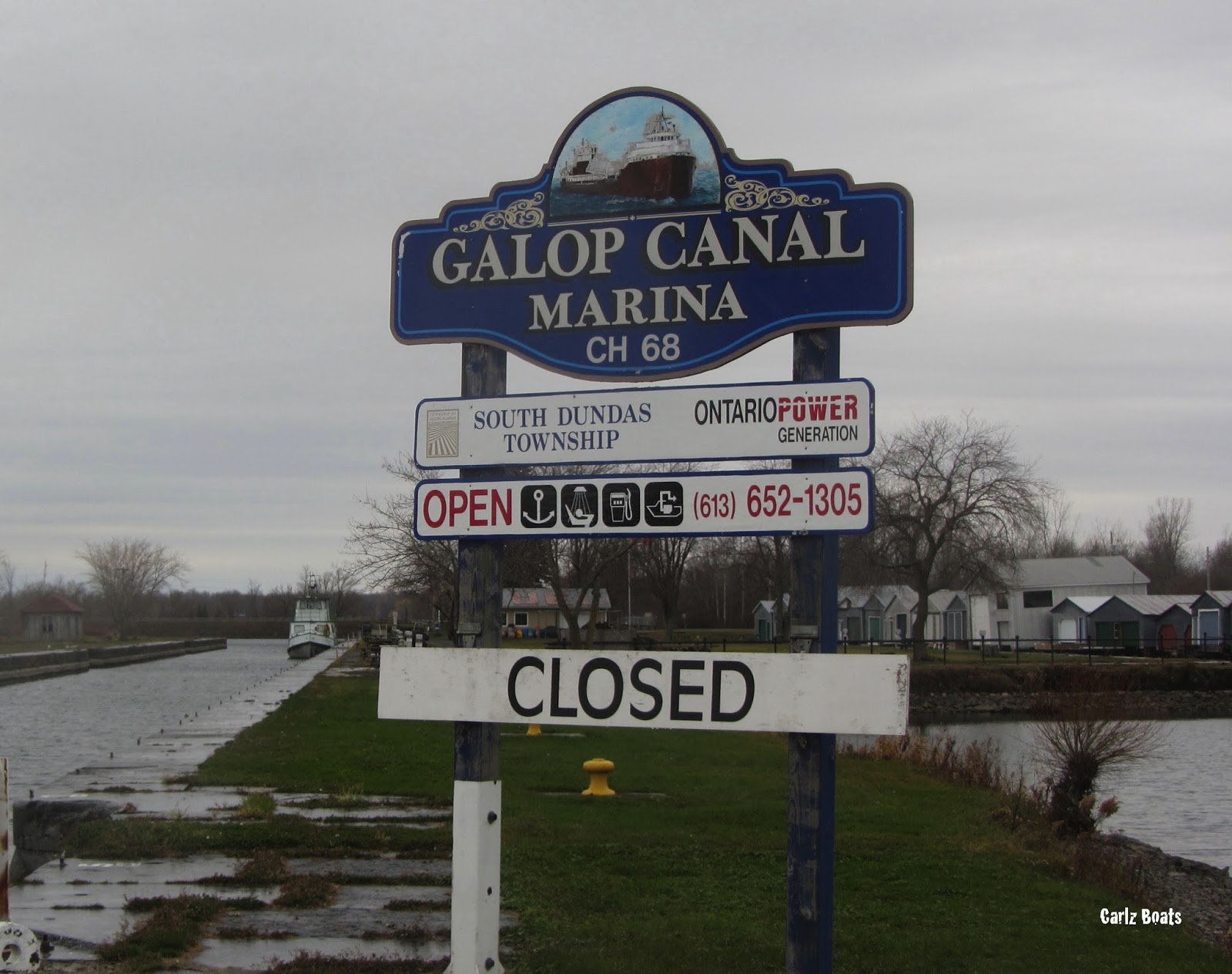
Old Iroquois Lock at the eastern entrance to the former Galop Canal has to be one of my most favourite locations to snap boats since starting this blog just over three and half years ago. The place has a lot of sentimental value for me because as my Dad told me just months before he died, it was a lock his boat, the BIRCHTON, would transit during their upbound passages to the Great Lakes. While so many other once historic structural marvels are torn down to make way for progress like what St. Catharines, Ontario did during the city's ongoing expansions by bulldozing over many sections of earlier Welland Canals to make way for the then new four-lane highway 406, this old 800' Lock 25 in Iroquois still appears a lot like what my Dad described twenty-four years ago.
True the gates are gone that once allowed canallers like my Dad's BIRCHTON (above, in a photo from Ron Beaupre's collection) to be lifted to the next level in the canal's 15.5' climb needed to bypass three sets of rapids, but the remaining original stone walls, tie-off snub-posts and weathered lockmaster's shack in plain sight offers an ideal setting to snap either an upbound in the distance slowing down as she approaches the current Iroquois Lock, or a downbound kicking up a wake while motoring on to the next Seaway lock, Eisenhower or destinations beyond below. Here's a few examples:
Upbound Algoma Central self unloader ALGOMA ENTERPRISE - September 14, 2015
Upbound Polesteam bulk carier OLZA - November 13, 2015
Upbound Algoma Central self unloader ALGOLAKE - October 18, 2015
Downbound former Canada Steamship Lines bulk carrier BIRCHGLEN - May 19, 2013
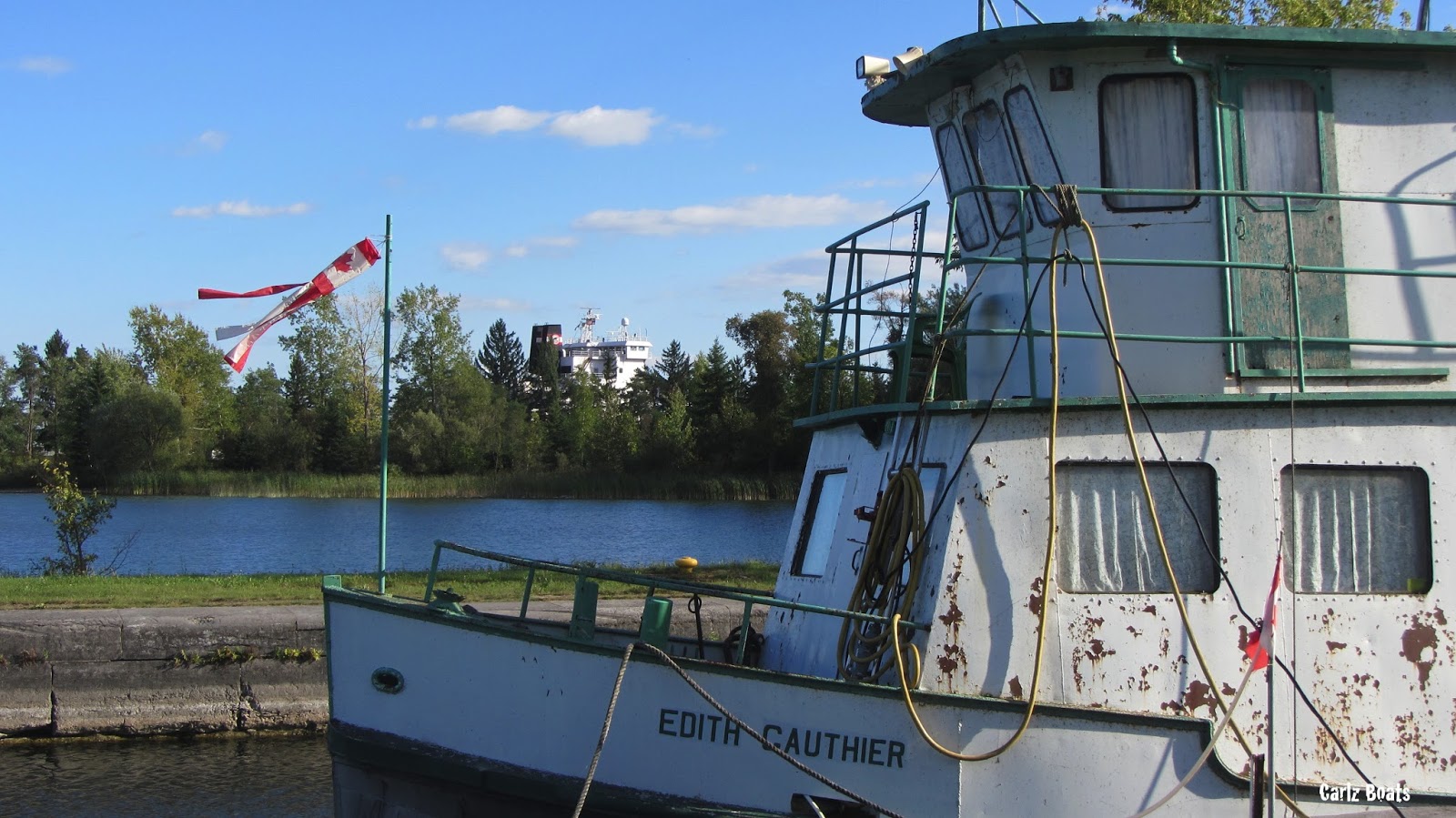
No matter what direction I gaze or snap, I can see what my Dad was talking about except, what's that across from the shack, along the lock's north wall? Is it a tug, or a fishing boat? All her curtains are drawn, so could she be a houseboat? One thing is for certain though, she's always there. With the exception of a Canada flag and wind-sock fluttering in the breeze in the more recent snaps above, the little boat has remained lifeless during every one of my visits to the lock which is also being used as a marina.
Her name is EDITH GAUTHIER  and according to what has been painted on her stern, her homeport is Midland, Ontario.  "So what brought you here, little lady to this lonely lock wall along the old Galop Canal.? What is your story?"

For much of my research, the 56' steel-hulled timid miss remained a mystery as all I could find out more from my friends, was that she was built as tug at George Gamble Shipyards of Port Dover, Ontario in 1934 and for Charles H. Gauthier of East Windsor. Not much to go with, I thought until I found out more about Mr. C.H. Gauthier, who since before the turn of the twentieth century, owned a flourishing fishing fleet and packing plant near the mouth of the French River, which flows into northern waters of Georgian Bay. COOL!! c):-o, I thought but then thanks to Mr. Google, the story got even better.
In an article I found entitled "Commercial Fishing, Key Harbour Area" written by Susan McKay in the summer of 2009 KEY EXCHANGE, there's a description in one paragraph on page 3 that talks about the picture below which was taken in the 1950's and that the larger vessel (centre) is the EDITH G, Gauthier's new fish tug. The article goes on to say that it was a steel-hulled tug and she had the latest equipment. It's a very interesting article and feel free to check it out by clicking on to this link:  (http://www.kraa.ca/KeyExchange/KeyExchangeSummer2009.pdf)
I must admit that with the exception of the current raised wheelhouse, the tug in the photocopied displayed the same lines and look as the tied off at Iroquois Lock, EDITH GAUTHIER and if it were her, how did she end up on the St. Lawrence River? c):-s The mystery continued...


...until I decided to contact her current owner, Ronald J. Cowalchuk of Gloucester, Ontario whose name was mentioned on the EDITH GAUTHIER's Transport Canada vessel registration document which was processed in 1973. I lucked out on my first call, and what a worthwhile discussion it was. Basically, Mr. Cowalchuk verified everything that I had found online and included that Gauthier Fisheries specialized in marketing whitefish and since the EDITH was the largest tug in their fleet and equipped with a refrigeration system, smaller fishing boats would transfer their catch to her. The EDITH GAUTHIER was a powerful boat, made of steel and had a reinforced ice breaking bow, which all were very important traits because she was tasked to get her valuable combined catch on the next available train to Toronto from the main railway terminus that was located then in the Midland, Ontario. Ah, Midland (homeport) c):-D  
When he purchased her in 1984,  Ronald Cowalchuk became the second owner of the GAUTHIER after the fishing company closed in the 1960's due to  declining stocks and the arrival of invasive species like lamprey eels which entered the Great Lakes soon after the opening of the St. Lawrence Seaway. After leaving the dry dock with an extended and raised superstructure along with a new Detroit diesel engine, EDITH GAUTHIER was motored to the St. Lawrence River and started a new career as a scuba-diving tender. With the St. Lawrence known for its fresh water diving, the EDITH offered easy access to the many well preserved 150 year old sunken wooden vessels and the space to accommodate up to sixteen divers and their equipment at one time. However due to ongoing classification issues with the Department of Transportation, Ronald Cowalchuk's dive tender and excursion business closed in 2002.

From "Pride of the Fleet" fish-tug, to versatile platform for scuba-divers, to a home-away-from-home houseboat, EDITH GAUTHIER's
outcome hasn't been that bad, like others of her kind becoming homes to spiders and snake while left high and dry in a farmer's field or fodder for a breaker's torch. As for me, EDITH GAUTHIER makes a photo great either as a prop or on her own. She was also subject of my 2015 Christmas winter watercolour entitled "Winter Lockage". So until my next visit to old Iroquois Lock, live on my little lonely lady. c):-))....


Page-viewer gallery and more answers about the Mystery Boat EDITH GAUTHIER:


Steve Briggs who's the administrator for the Facebook group "Russel Brothers Boats" and RUSSELBROTHERS.CA sent me this photo from the Bob Plakholm photo collection of the EDITH GAUTHIER still resembling the traditional "tug" look from when she was built on 1934 by George Gamble in Port Dover. Sitting high on shore, EDITH GAUTHIER was at Russel Brothers Boats shipyard in 1967 for repairs and obviously a new coat of paint, which glistens in Mr. Plakholm's photo.

Also an interesting comment below by Charles Gauthier of Windsor who mentioned that his dad, Falconer Gauthier owned the EDITH GAUTHIER when he ran the fisheries after the passing of his father, C.H. Gauthier. Thanks for your input Steve Briggs and Charles Gauthier. You've answered a lot of questions but there's still one mystery, who was her namesake, "EDITH GAUTHIER"?
- Ask and you shall receive, as earlier this month (September 6, 2019) Charles Gauthier of Windsor was kind enough again to send along even more interesting information that: the "EDITH GAUTHIER" was name after C.H. Gauthier's wife, Edith.  

Very interesting indeed and is there more information to be told about this mystery boat? Well, apparently so... 

EDITH GAUTHIER before conversion to dive tender.
Unknown photographer provided to thread by Rick Stout 
March 8, 2026

...Earlier I mentioned that when Ronald Cowalchuk purchased the EDITH GAUTHIER in 1984,  he was the second owner of the then fish-tug which was sold when Mr. Charles H. Gauthier's Georgian Bay fishing company was closed in the 1960's due primarily to declining stocks. But the question that remained, who was the first owner?

Well just when you think you've heard it all, along comes another email from someone who happened to find my old blogpost and says, here's what I know about that...

...According to Tom Barber, the vessel belonged to his father-in-law from the early 1970's until 1987 and it was known as the CHRISTINE W., which was the name of his first granddaughter. He completely changed her appearance and actually lived onboard for several years. It spent all those summers on Georgian Bay. The CHRISTINE W. was drydocked twice for hull inspections, once in Midland and once in Collingwood. Tom Barber didn't mention his father-in-law's name in his email, however in a comment I recently found in a March 2021 Ship Junkie's - Lakes, Locks & Rivers (LL&R) thread, my ship-watching friend and marine artist, Paul Ingram mentioned that Carl Weinart  (perhaps the "W" of the CHRISTINE W ?) bought the fish-tug from C.H. Gauthier in 1969, and converted it into a dive tender.  

A lot of answers to many questions but there's still one more unknown. Last I was at the old Galop Canal Iroquois,  EDITH GAUTHIER wasn't there, so Where's the Mystery Boat now?
This vessel belonged to my father-in-law from the early 70's until 1987 as the Christine W., the name of his first granddaughter. He completely changed her appearance and actually lived aboard for several years. I can supply you with a photo if you wish. It spent all those summers on Georgian Bay. Was drydocked twice for hull inspections, once in Midland, once in Collingwood.
...in that same Ship Junkie's - Lakes, Locks & Rivers (LL&R) thread, Paul Ingram went on to mention...under her own power, the EDITH GAUTHIER motored to Kingston for a survey and inspection at the dry dock there in 2020. Tied off next to a dock crane, Rick Stout took the above photo of the her with what looks to be a new coat of paint in his photo on March 22, 2021 in Kingston. I could be wrong, but that looks like  EDITH GAUTHIER in this Google Map satellite view of Davis Drydock in Kingston in my recent screenshot. To be confirmed on my next visit to Kingston so, the mystery continues...